

When planning the electrical layout and infrastructure for your new home in India, choosing the right air conditioning system is one of the most consequential decisions you will make. Beyond day-to-day comfort, this choice directly impacts your monthly utility bills, long-term equipment lifespan, and overall home energy efficiency.
With soaring summer temperatures across the subcontinent and updated energy standards from the Bureau of Energy Efficiency (BEE), understanding the core differences between inverter and non-inverter technology is vital.Today, inverter air conditioners command over 65–70% of the urban Indian market. However, selecting the ideal system depends heavily on your region, daily usage hours, and household budget.
1. Core Technology: How They Work
Build cost · Bengaluru, May 2026
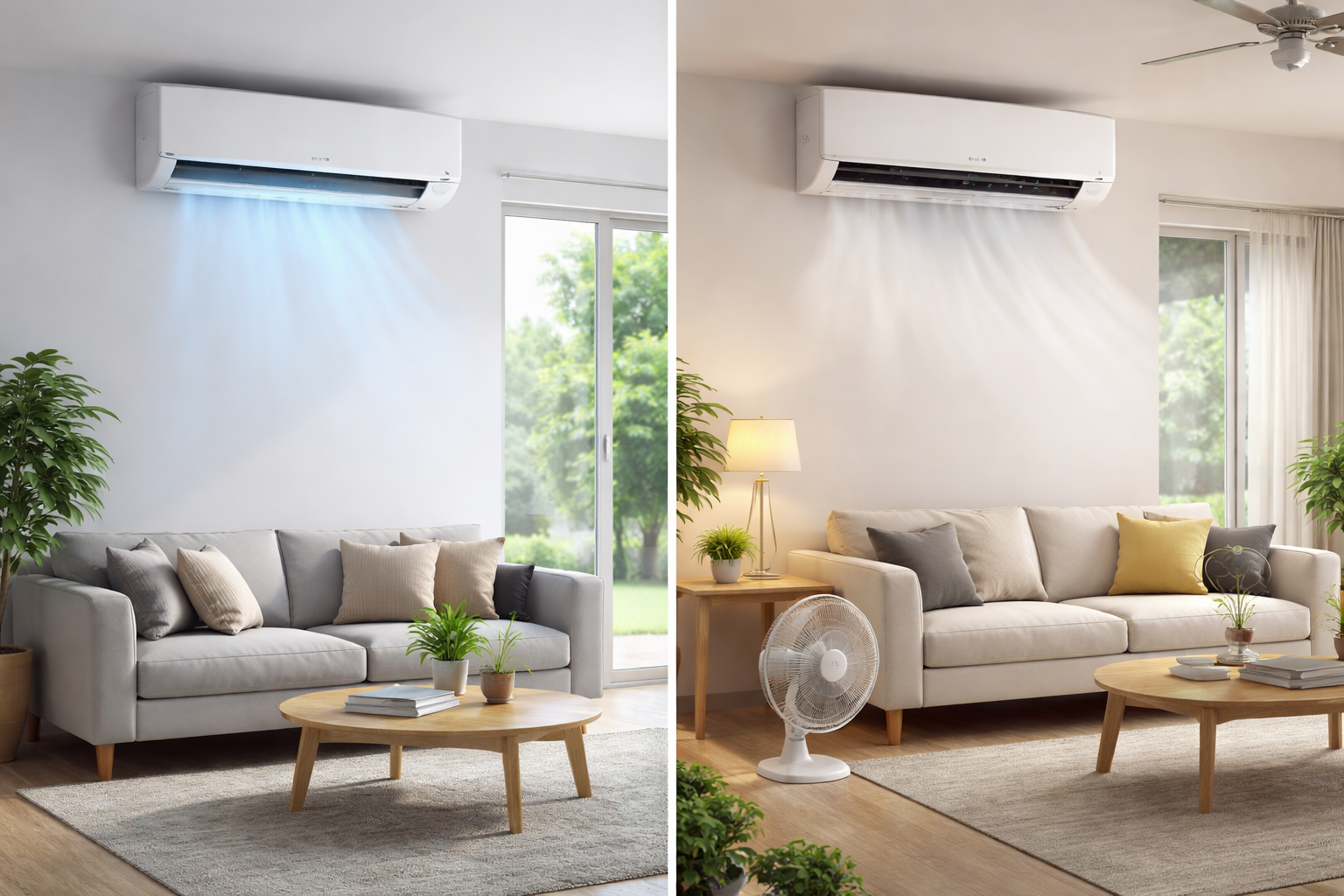
Non-Inverter ACs (Fixed-Speed)
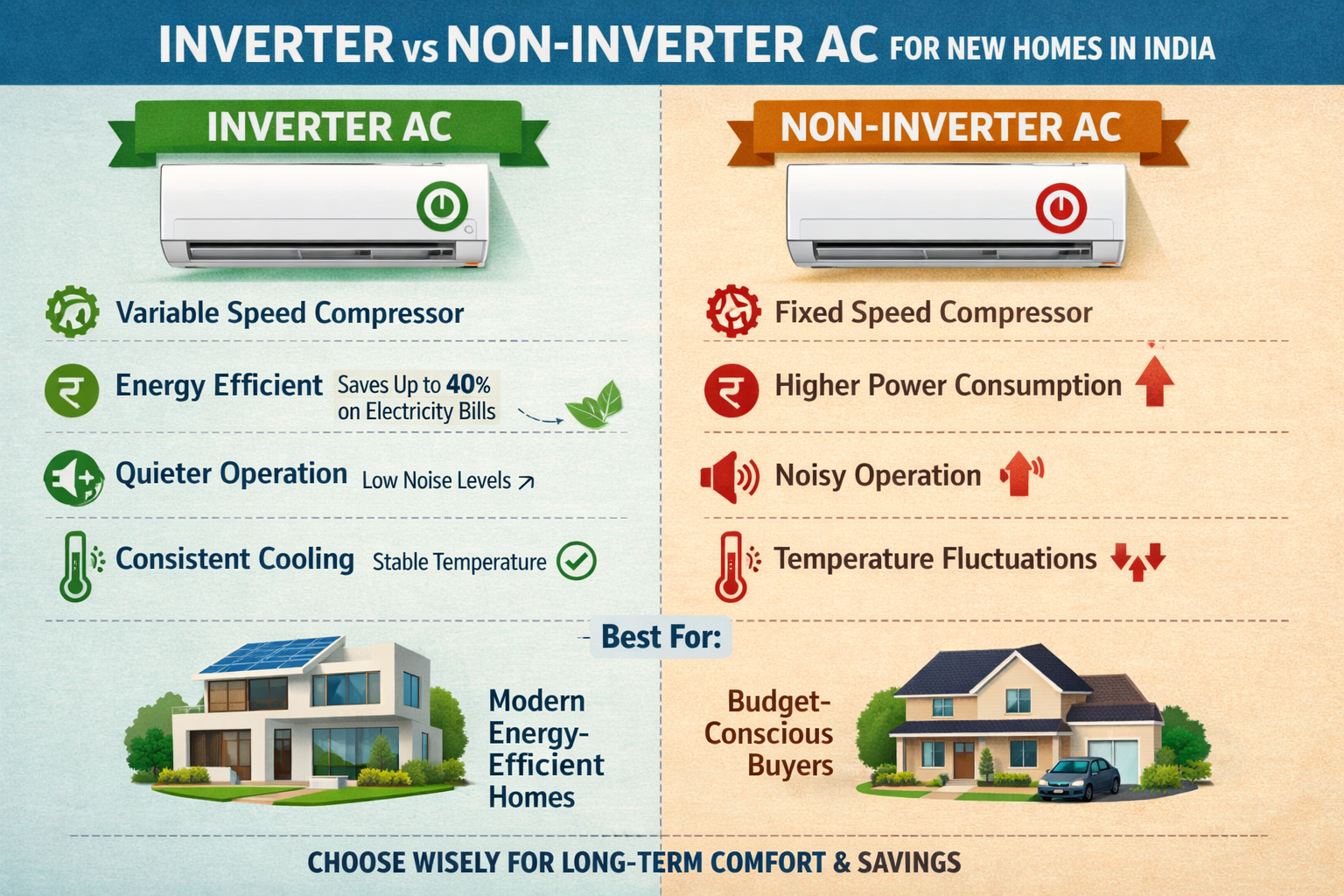
Non-inverter systems operate on a binary principle: fully on or fully off (similar to a standard light switch).
When you set a target temperature (e.g., 24°C), the compressor runs at maximum capacity until the room hits that target, then shuts off entirely.
Once the room temperature rises again, the compressor kicks back on at full power.
This constant cycle creates mechanical stress and a "sawtooth" fluctuation in room temperature.
Inverter ACs (Variable-Speed)
Inverter systems use variable-speed compressors that modulate their operating frequency continuously.
Instead of shutting off, the compressor slows down or speeds up to match the exact thermal load of the room.
When you turn it on, it ramps up for rapid cooling; as the room approaches your target temperature, the compressor scales back to a low, steady hum to maintain that exact climate.
This continuous modulation prevents sharp temperature swings and drastically reduces power spikes
2. Navigating the 2026 BEE Star Rating Norms
If you are buying a new AC, you must pay close attention to the updated BEE star rating guidelines.
The ISEER Metric: Inverter AC efficiency is measured using the Indian Seasonal Energy Efficiency Ratio (ISEER), which evaluates performance across varying part-load and ambient conditions unique to India.
Tightened Thresholds: The BEE has significantly raised energy efficiency thresholds. A 5-star model from previous years translates to a 4-star model under current standards.
Choosing Your Star Tier:
3-Star Inverter ACs (ISEER 4.0–4.99): Ideal for rooms used moderately (4 to 5 hours daily), striking a balance between initial purchase price and running costs.
5-Star Inverter ACs (ISEER 5.6+): Highly recommended for heavy users running systems 6 to 8+ hours a day in high-temperature regions, offering maximum lifetime savings.
Frequently asked
3. Upfront Investment vs. Long-Term Operating Costs
Feature | Inverter AC | Non-Inverter (Fixed-Speed) AC |
Upfront Price (1.5 Ton) | ₹30,000 – ₹45,000 | ₹25,000 – ₹35,000 |
Average Power Draw | 0.7 to 1.1 kW (variable) | 1.5 to 1.7 kW (constant full load) |
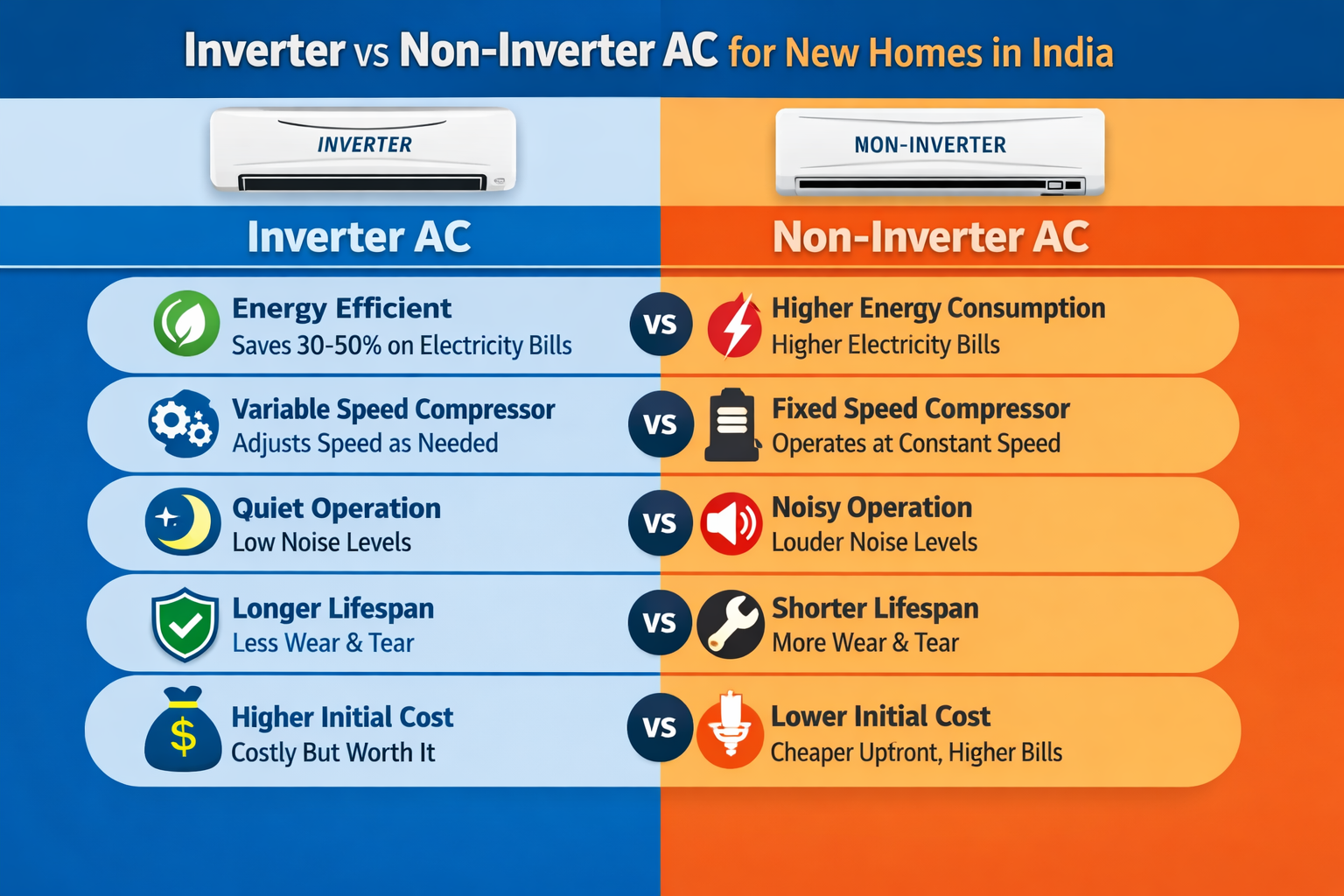
Noise Level | Quiet (22–45 dB) | Louder (48–55 dB) |
Temperature Stability | Highly stable ($\pm 0.5^\circ\text{C}$) | Fluctuating ($\pm 2^\circ\text{C}$ to $3^\circ\text{C}$) |
Average Lifespan | 12–15 years | 8–10 years |
Payback Period | — | 2 to 3 years of heavy use |
Financial Breakdown
While a quality inverter AC carries a price premium, its continuous efficiency translates to 30% to 50% lower electricity consumption compared to a fixed-speed unit during extended runtime.For households running an AC for 6–8 hours a day during peak summer, the higher initial cost is typically recovered through electricity bill savings within 2 to 3 years.
4. Regional Considerations Across India
Northern India (Delhi, NCR, Rajasthan, Punjab): Extreme summers exceeding 45°C make long operating hours mandatory. Here, a 5-star inverter AC is virtually a necessity to keep monthly electricity bills manageable.
Southern & Coastal India (Chennai, Mumbai, Kerala): High humidity levels mean ACs run for extended portions of the year. Inverter technology excels here by efficiently managing continuous latent heat loads while maintaining stable indoor humidity control.
Moderate Climates (Bangalore, Pune): Because ambient temperatures rarely stay aggressively high year-round, a 3-star inverter AC or even a budget-friendly fixed-speed model for guest rooms can suffice if usage is kept minimal.
Stable Comfort with Inverter ACs
Inverter ACs maintain your set temperature within ±0.5°C, providing consistent comfort. The variable-speed compressor adjusts seamlessly to maintain the desired temperature, eliminating the on-off cycling. This stability is particularly valuable in bedrooms where temperature consistency promotes better sleep.
Studies indicate that inverter ACs are preferred by 78% of users who have experienced both technologies, primarily due to superior comfort levels.
Noise Levels and Operational Quietness
Noise from Non-Inverter ACs
Non-inverter ACs typically generate 50-60 decibels of noise during operation. The sudden startup of the compressor at full capacity creates noticeable sound, which can be disruptive, especially at night. The repetitive on-off cycling also means constant noise interruptions.
Quieter Operation of Inverter ACs
Inverter ACs operate at 22-32 decibels on average, comparable to a whisper or quiet library. Since the compressor runs continuously at varying speeds rather than cycling on and off, there are no sudden startups or shutdowns. Modern inverter ACs with advanced noise reduction technology can operate as quietly as 18-22 decibels.
For apartment dwellers in Indian cities where noise pollution is already a concern, inverter ACs offer a significant quality-of-life improvement.
Environmental Impact and Sustainability
Carbon Footprint Considerations
With India's electricity grid still heavily dependent on coal (approximately 50% of generation), reducing energy consumption directly reduces your carbon footprint. An inverter AC consuming 7 kW annually versus 15 kW for a non-inverter model prevents approximately 3.2 tons of CO₂ emissions over 10 years (based on average Indian grid emissions).
As India targets net-zero emissions by 2070 and promotes renewable energy adoption, choosing energy-efficient appliances aligns with national sustainability goals. The Government of India's STAR (Super-efficient, Appliance Labeling Program) has been instrumental in promoting inverter AC adoption.
Refrigerant Efficiency
Modern inverter ACs also use eco-friendly refrigerants like R32, which have zero ozone depletion potential and lower global warming potential compared to older R22 refrigerants still found in some non-inverter models.
Maintenance and Longevity
Maintenance Requirements
Non-inverter ACs have fewer electronic components, making them simpler to maintain. Regular servicing involves cleaning filters and coils, which costs approximately ₹500-1,000 per service in most Indian cities.
Inverter ACs require more sophisticated servicing due to their electronic components. However, because they operate at lower stress levels (variable speed vs. maximum capacity), the compressor and other mechanical parts experience less wear. Annual servicing costs are similar (₹800-1,500), but the frequency might be slightly higher for comprehensive checks.
Expected Lifespan
Non-inverter ACs typically last 8-10 years with proper maintenance. Inverter ACs, despite their complexity, often last 12-15 years because the variable-speed operation reduces mechanical stress. The compressor in an inverter AC, which is the most expensive component, experiences significantly less wear.
Making the Right Choice for Your New Home
Choose Non-Inverter AC If:
Your budget is strictly limited to ₹25,000-30,000 for initial purchase
You live in a region with moderate temperatures (Bangalore, Pune, coastal areas) and use AC sparingly
You plan to stay in the home for less than 4 years
You prefer simpler technology with readily available local technicians
You have inconsistent electricity supply and prefer robust, simple systems
Choose Inverter AC If:
You live in high-temperature regions (Delhi, Hyderabad, Rajasthan) where AC usage is extensive
You plan to stay in the home for more than 5 years
Comfort and temperature stability are priorities (especially for bedrooms)
You're environmentally conscious and want to reduce your carbon footprint
You value quiet operation and minimal noise disruption
You can afford the ₹15,000-20,000 premium for long-term savings
Integration with Home Automation and Smart Features
Modern inverter ACs integrate seamlessly with smart home systems, a consideration for new homes being built today. Most contemporary inverter AC models offer WiFi connectivity, allowing you to control temperature from your smartphone, set schedules, and monitor energy consumption in real-time.
Non-inverter ACs rarely come with smart features, and retrofitting them is complicated. If you're designing a modern home with smart home integration, inverter ACs are the natural choice.
Platforms like AECORD can help you source inverter ACs with smart features from verified manufacturers and suppliers, ensuring quality and warranty compliance specific to Indian standards. 5. Final Verdict: Which One Should You Buy for Your New Home?
Choose an Inverter AC If:
You plan to use the air conditioner daily for 6 or more hours.
You live in an area with intense summer heat or prolonged high humidity.
Temperature stability and low operational noise (essential for bedrooms) are high priorities.
You view your appliance as a long-term investment (10+ years).
Choose a Non-Inverter AC If:
The unit is intended for an infrequently used guest room, home office, or a rental property where usage is strictly occasional.
Your initial capital expenditure for the home build/renovation is rigidly constrained.
Regional Considerations Across India
Northern India (Delhi, Punjab, Haryana)
With summer temperatures reaching 45-48°C and AC usage extending 6-7 months, inverter ACs deliver maximum savings here. Annual electricity savings of ₹12,000-15,000 make the investment highly worthwhile.
Southern India (Chennai, Hyderabad, Bangalore)
Chennai experiences intense cooling needs year-round, making inverter ACs ideal. Bangalore and Pune have moderate climates where the inverter advantage is less dramatic but still significant (₹5,000-8,000 annual savings).
Western India (Mumbai, Ahmedabad, Gujarat)
Mumbai's coastal climate and moderate temperatures mean moderate cooling needs. However, high electricity costs (₹9-10 per kWh) make inverter ACs more economical. Gujarat's dry heat and high temperatures favor inverter adoption.
Eastern India (Kolkata, Patna)
Moderate cooling needs and lower electricity costs (₹6-7 per kWh) mean slower payback periods. However, the superior comfort of inverter ACs still justifies the investment for most households.
Warranty and After-Sales Support
Most inverter ACs come with 5-year compressor warranties and 2-year overall warranties. Non-inverter ACs typically offer 3-year compressor and 1-year overall warranties. Given that inverter ACs last longer, the extended warranty terms reflect manufacturer confidence in the technology.
Service center availability varies by brand and region. In metropolitan areas, both technologies have excellent support networks. In Tier-2 and Tier-3 cities, non-inverter ACs might have more local technician availability, though this gap is narrowing as inverter ACs become mainstream.
Government Incentives and Subsidies
Several Indian states offer subsidies for purchasing energy-efficient appliances. Under the UJALA scheme (Unnat Jyoti by Affordable LEDs for All), the government promotes efficient cooling solutions. Some state electricity boards offer rebates of ₹2,000-5,000 on inverter AC purchases.
Check with your local electricity distribution company or state energy department for current incentive programs. These can significantly reduce the effective cost difference between inverter and non-inverter ACs.
Frequently Asked Questions
Do inverter ACs really save ₹7,000-8,000 annually in electricity bills?
Yes, in most Indian homes with regular AC usage. The actual savings depend on your location's temperature, electricity rates, and usage hours. In Delhi with ₹8/kWh rates and 8 hours daily usage, savings reach ₹7,000+. In Bangalore with moderate cooling needs, savings might be ₹4,000-5,000. Use online calculators provided by AC manufacturers to estimate savings for your specific situation.
Can I install an inverter AC in a home with unstable electricity supply?
Modern inverter ACs have built-in voltage stabilizers and can handle fluctuations of ±15-20%. However, in areas with severe power instability (frequent blackouts or voltage swings beyond ±25%), non-inverter ACs might be more reliable. Alternatively, pair an inverter AC with an external voltage stabilizer (₹3,000-5,000) for protection.
What's the payback period for the extra cost of an inverter AC?
In high-temperature regions like Delhi and Hyderabad, the payback period is 2-3 years. In moderate-climate cities like Bangalore and Pune, it extends to 3-5 years. The calculation: (Price difference) ÷ (Annual electricity savings) = Payback period. With government subsidies, payback periods can reduce by 6-12 months.
Are inverter ACs more difficult to repair than non-inverter models?
Inverter ACs are more complex, but they require repairs less frequently due to lower mechanical stress. When repairs are needed, they should be handled by trained technicians rather than general mechanics. Service costs are comparable to non-inverter ACs (₹1,500-3,000 per repair), but the frequency is typically lower over the AC's lifetime.
Which brands offer reliable inverter ACs in India?
Top brands include Daikin, LG, Voltas, Carrier, Blue Star, and Godrej. These offer 5-star inverter models with good warranty support across Indian cities. Mid-range options from Midea and Lloyd provide good value. When sourcing through platforms like AECORD, you can compare specifications, warranties, and verified supplier reviews to make an informed choice aligned with your budget and requirements.