




15 Iconic Indian Buildings That Showcase Architectural Innovation and Engineering Excellence
India's architectural landscape is a testament to centuries of cultural evolution, technological advancement, and creative vision. From ancient temples to modern skyscrapers, Indian buildings represent a remarkable blend of traditional craftsmanship and contemporary engineering. These structures not only define our cities' skylines but also serve as inspiration for architects, engineers, and construction professionals across the globe.
Whether you're an architect seeking design inspiration, an engineer interested in structural innovations, or a construction professional looking to understand India's building heritage, this comprehensive guide explores 15 of India's most famous buildings. Each structure tells a unique story of innovation, cultural significance, and engineering excellence that continues to influence the AECO industry in India./blog/how-to-vet-an-architect-in-india
Build cost · Bengaluru, May 2026
Understanding India's Architectural Heritage
Indian architecture is distinguished by its diversity and adaptability. The country has witnessed numerous architectural movements—from the Mughal era to British colonial influence and modern contemporary design. What makes Indian buildings particularly noteworthy is how they balance aesthetic appeal with functional excellence, often incorporating sustainable practices that have been refined over generations.
For professionals in the architecture, engineering, construction, and operations (AECO) sector, studying these iconic structures provides valuable insights into material selection, design principles, and construction methodologies that have proven successful in India's diverse climate and geographical conditions.
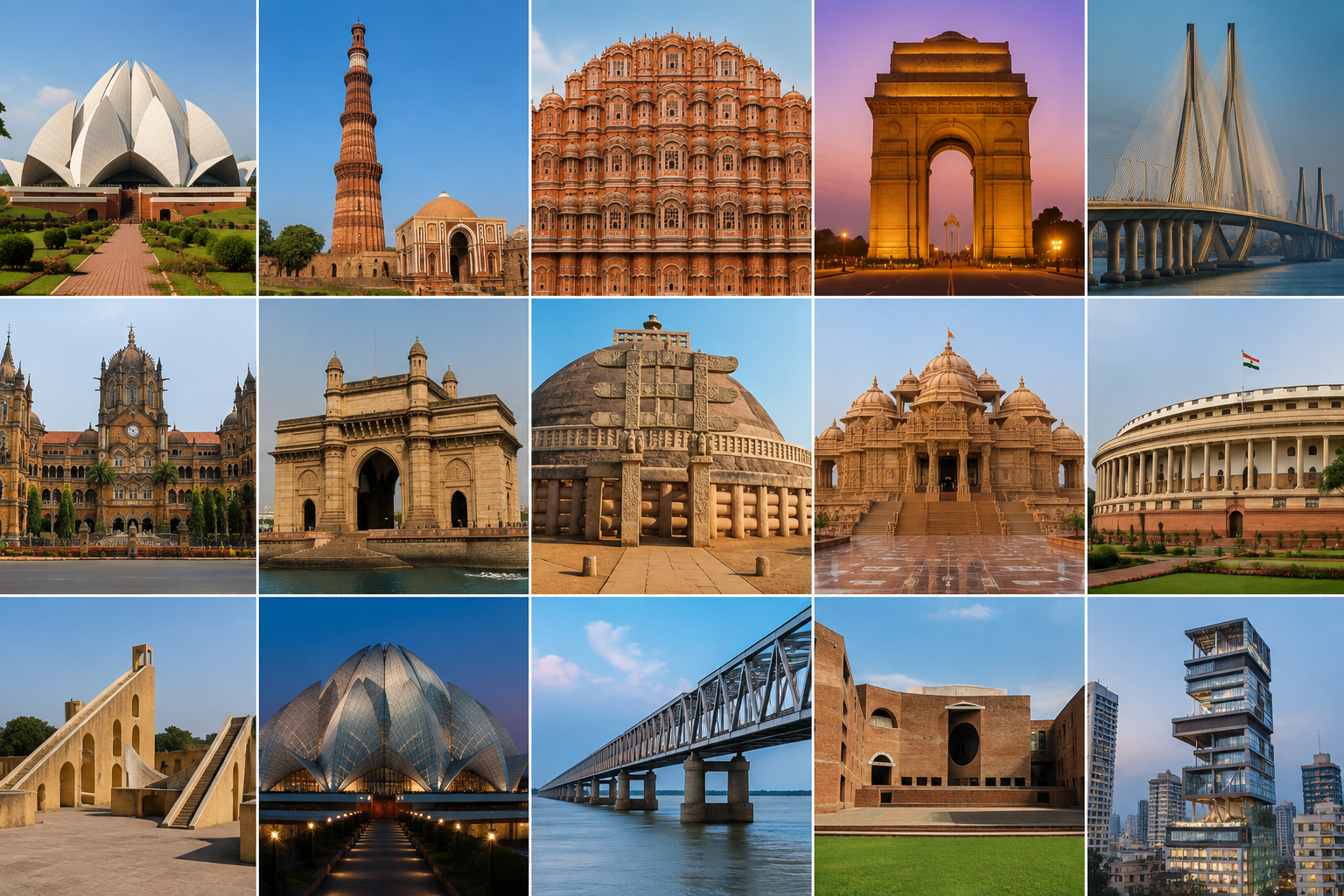
The 15 Most Famous Buildings in India
1. Taj Mahal, Agra
The Taj Mahal stands as perhaps the world's most recognizable symbol of love and architectural perfection. Built between 1632 and 1653 by Mughal Emperor Shah Jahan, this white marble mausoleum represents the pinnacle of Mughal architecture.
Architectural Significance: The structure showcases perfect symmetry, intricate marble inlay work, and sophisticated proportional systems. The dome design, standing 73 meters high, demonstrates advanced understanding of structural engineering for its era. The marble used was sourced from Makrana in Rajasthan, a practice that continues in premium construction projects today.
Engineering Marvel: The foundation system uses a unique combination of lime mortar and brick that has proven remarkably durable over 370 years. The acoustic properties of the main chamber are engineered to create perfect sound reflection, a feat that modern engineers still study.
Frequently asked
2. India Gate, New Delhi
Designed by Sir Edwin Lutyens, India Gate is a war memorial and iconic landmark completed in 1931. Standing 42 meters tall, this structure represents the transition between colonial and Indian architectural aesthetics.
Structural Innovation: The gate features a distinctive arch design built with Dholpur and Agra red sandstone. The structural system was revolutionary for its time, utilizing advanced load distribution techniques to support the massive central dome without internal support columns.
Modern Relevance: India Gate's restoration in recent years employed modern conservation techniques while preserving original materials and methods, providing valuable lessons for heritage building maintenance professionals.
3. Hawa Mahal, Jaipur
The Palace of Winds, constructed in 1799, is one of the most distinctive examples of Rajasthani architecture. This five-story pink sandstone structure features 953 small windows designed in a honeycomb pattern. /blog/bijoy-jain-and-studio-mumbai-the-indian-architect-redefining-sustainable-luxury
Innovative Design Purpose: The windows were specifically designed to allow royal women to observe street life while remaining unseen—a functional design solution that demonstrates how aesthetics and purpose can merge seamlessly. The ventilation system created by the window arrangement naturally cools the interior, a principle relevant to sustainable building design today.
Construction Technique: Built without any binding material, the structure relies entirely on the precision of stone cutting and gravity, showcasing exceptional craftsmanship that modern construction professionals can learn from when working on heritage restoration projects.
4. Gateway of India, Mumbai
Completed in 1924, the Gateway of India is an iconic arch monument built to commemorate King George V's visit to India. This Indo-Saracenic structure has become synonymous with Mumbai's identity.
Architectural Blend: The monument combines Islamic and Gothic architectural elements, featuring a 26-meter high arch constructed from yellow and blue basalt stone. The design reflects the cultural synthesis characteristic of colonial-era Indian architecture.
Construction Challenge: Built on reclaimed land with challenging soil conditions, the foundation engineering required innovative solutions for its time. The project cost approximately ₹21 lakh (equivalent to several crores today), making it an expensive undertaking that demonstrated India's construction capabilities.
5. Mysore Palace, Karnataka
This grand royal residence, reconstructed after a fire in 1897, represents Indo-Gothic architecture at its finest. The palace covers an area of 245,000 square feet and remains one of India's most visited monuments.
Architectural Features: The structure showcases intricate wooden carvings, ornate doors, and decorative elements that required exceptional craftsmanship. The use of local materials combined with imported architectural styles created a unique aesthetic identity.
Structural Engineering: The palace's construction employed advanced techniques for its era, including sophisticated drainage systems and ventilation design that maintained comfortable interior conditions despite Karnataka's warm climate.
6. Victoria Terminus, Mumbai
Now the headquarters of Central Railways, Victoria Terminus (renamed Chhatrapati Shivaji Terminus) is a masterpiece of Victorian Gothic Revival architecture completed in 1888. The central dome rises 78 meters above ground level.
Architectural Grandeur: The building features ornate turrets, arches, and decorative stonework that showcase Victorian design principles adapted to the Indian context. The stained glass windows, imported from England, add to its aesthetic appeal.
Functional Excellence: Despite its ornate appearance, the building efficiently handles thousands of commuters daily, demonstrating how aesthetic design and functional efficiency can coexist. The recent restoration project, completed in 2020, cost over ₹400 crores and employed modern conservation techniques while preserving historical integrity.
7. Parliament House, New Delhi
Designed by British architects Herbert Baker and Edwin Lutyens, Parliament House was completed in 1927. The circular structure represents a unique interpretation of democratic architecture.
Design Philosophy: The circular plan symbolizes equality and unity, with all members positioned at equal distance from the center. The building incorporates Indian architectural elements, including carved stone screens and decorative motifs.
Engineering Achievement: The building covers 87,000 square meters and was constructed using advanced structural systems for its era. The recent renovation project (2017-2022), costing over ₹971 crores, incorporated modern safety systems, accessibility features, and sustainable technologies while maintaining the original architectural character.
8. Brihadeeswarar Temple, Thanjavur
Built in the 11th century by Chola Emperor Rajaraja I, this temple represents the zenith of Dravidian architecture. The main tower (vimana) stands approximately 66 meters tall and is among the tallest structures of its era.
Structural Marvel: The temple was constructed entirely without mortar, using precisely cut granite blocks. The main dome, made of a single stone weighing approximately 216 tons, was hoisted to the top using an ingenious ramp system—a feat that demonstrates ancient Indian engineering prowess.
Durability and Sustainability: The temple has survived earthquakes and centuries of weathering, testament to superior material selection and construction techniques. The drainage systems and foundation design continue to protect the structure from water damage.
9. Sanchi Stupa, Madhya Pradesh
Dating back to the 3rd century BCE, Sanchi Stupa represents one of Buddhism's most sacred monuments. The hemispherical dome structure showcases ancient Indian architectural and engineering knowledge.
Construction Technique: Built using brick and stone without any binding material, the stupa demonstrates sophisticated understanding of load distribution and structural stability. The precise geometric proportions create both aesthetic harmony and structural integrity.
Historical Significance: The elaborate gateways feature intricate carvings that provide insights into ancient Indian craftsmanship and artistic expression, influencing contemporary architectural design philosophy.
10. Qutb Minar, New Delhi
Built in stages between the 12th and 16th centuries, Qutb Minar is a towering minaret reaching 72.5 meters in height. It represents Indo-Islamic architecture at its most impressive.
Structural Design: The minaret's tapering circular tower features five distinct architectural styles reflecting different construction periods. The interior spiral staircase with 379 steps demonstrates sophisticated spatial planning.
Material Innovation: The structure combines marble and sandstone with decorative calligraphy, showcasing how aesthetic and functional elements were integrated in medieval Indian architecture.
11. Rashtrapati Bhavan, New Delhi
The official residence of India's President, designed by Edwin Lutyens and completed in 1931, covers 200,000 square meters. This palatial structure represents the grandeur of colonial architecture.
Architectural Complexity: The building features 340 rooms, extensive gardens, and sophisticated infrastructure. The design incorporates Indian architectural elements with European classical styles, creating a unique synthesis.
Sustainability Features: Recent modernization efforts have introduced solar panels, rainwater harvesting systems, and energy-efficient lighting, demonstrating how heritage structures can be adapted for contemporary sustainability standards.
12. Charminar, Hyderabad
Built in 1591 by Muhammad Quli Qutb Shah, Charminar stands 56 meters tall and features four minarets at its corners. This iconic monument has become the symbol of Hyderabad's identity.
Architectural Features: The structure combines Persian and Indian architectural styles, with intricate arches, domes, and decorative elements. The four minarets are identical, emphasizing symmetry—a principle fundamental to Islamic architecture.
Functional Design: Originally serving multiple purposes—mosque, minaret, and fort—the structure demonstrates multi-functional design principles that remain relevant in contemporary architecture.
13. Meenakshi Temple, Madurai
One of India's oldest and most significant temples, Meenakshi Temple showcases Dravidian architecture at its most elaborate. The temple complex covers 14 acres with multiple gopurams (towers) reaching heights of up to 52 meters.
Architectural Complexity: The temple features approximately 33,000 sculptures and intricate carvings covering every surface. The proportional systems and spatial organization create a harmonious religious environment.
Construction Longevity: Despite continuous use for over 2,000 years, the temple remains structurally sound, demonstrating the durability of traditional construction methods and materials.
14. Lotus Temple, New Delhi
Completed in 1986, the Lotus Temple represents modern Indian architecture's commitment to innovation and sustainability. Designed by Iranian-Canadian architect Fariborz Sahba, this Bahai House of Worship features a unique lotus-shaped design.
Architectural Innovation: The structure comprises 27 marble and concrete petals arranged in three tiers, creating the distinctive lotus form. The building uses white marble from Makrana, connecting it to India's architectural heritage.
Engineering Excellence: The complex geometry required advanced structural engineering and computer-aided design. The building incorporates natural ventilation and lighting systems, making it an early example of sustainable design in India. The construction cost approximately ₹10 crores, representing significant investment in architectural innovation.
15. Rajabai Tower, Mumbai
Built in 1878, this 85-meter Gothic Revival tower stands in the Fort area of Mumbai. Designed by Frederick William Stevens, it represents Victorian Gothic architecture adapted to the Indian context.
Architectural Style: The tower features intricate stone carvings, pointed arches, and decorative elements characteristic of Gothic Revival. The clock mechanism, imported from England, remains functional after 145 years.
Urban Landmark: The tower serves as a prominent navigational landmark and has become an integral part of Mumbai's architectural identity, influencing contemporary urban design discussions.
Learning from India's Iconic Buildings
Material Selection and Durability
India's famous buildings demonstrate the importance of selecting appropriate materials for local climate conditions. The use of Makrana marble, Agra red sandstone, and granite has proven highly durable across centuries. Modern construction professionals working on projects across Indian cities—from Bangalore to Kolkata—can benefit from understanding these time-tested material choices.
Sustainable Design Principles
Many historic Indian buildings incorporated passive cooling, natural ventilation, and water management systems that align with contemporary sustainability goals. The honeycomb design of Hawa Mahal and the ventilation systems in ancient temples demonstrate that sustainability isn't merely a modern concern but has been central to Indian architecture for centuries.
Structural Innovation
From the dome of Taj Mahal to the tapering structure of Qutb Minar, Indian buildings showcase innovative approaches to structural design. These examples provide valuable case studies for contemporary engineers working on complex projects in India's diverse geographical and climatic regions.
The Role of AECORD in Connecting Professionals
For architects, engineers, and construction professionals in India, understanding these iconic buildings provides essential context for contemporary practice. Whether you're working on heritage restoration, new construction, or renovation projects, the principles demonstrated by these structures remain relevant.
AECORD, India's B2B2C marketplace for AECO professionals, connects you with experts who understand India's architectural heritage and contemporary building standards. Whether you need structural engineers familiar with heritage conservation, architects experienced in blending traditional and modern design, or construction professionals with expertise in specific regions, AECORD helps you find the right professionals for your projects.
Conclusion
India's famous buildings represent more than just architectural achievements—they embody centuries of cultural evolution, technological advancement, and creative excellence. From the mathematical precision of the Taj Mahal to the innovative sustainability features of the Lotus Temple, these structures continue to inspire and educate professionals in the AECO industry.
Whether you're designing a new building, restoring a heritage structure, or managing a construction project, these iconic buildings offer valuable lessons in material selection, structural design, spatial planning, and sustainable practices. By understanding the principles that made these structures endure, contemporary professionals can create buildings that are not only functionally excellent but also architecturally significant.
As India continues to grow and develop, the architectural heritage represented by these 15 buildings serves as both inspiration and guidance for the next generation of construction professionals. When you're ready to bring your architectural vision to life or need expert consultation for your project, connect with experienced AECO professionals on AECORD who understand India's rich architectural traditions and contemporary building requirements.
```
Frequently Asked Questions
What are the most famous buildings in India that showcase architectural innovation?
India's most iconic buildings include the Taj Mahal in Agra, India Gate in New Delhi, and Hawa Mahal in Jaipur. These structures represent different architectural eras—from Mughal to colonial to Rajasthani styles—and demonstrate innovative engineering solutions that continue to influence modern AECO professionals.
What makes Indian architecture unique and relevant for construction professionals?
Indian architecture uniquely balances aesthetic appeal with functional excellence while incorporating sustainable practices refined over generations. These buildings showcase advanced material selection, design principles, and construction methodologies specifically adapted to India's diverse climate and geographical conditions.
How has the Taj Mahal remained structurally sound for over 370 years?
The Taj Mahal's durability comes from its innovative foundation system combining lime mortar and brick, along with Makrana marble that has proven exceptionally resistant to weathering. Its sophisticated proportional systems and advanced structural engineering for its era have made it a case study for modern engineers and conservationists.
What engineering innovations can modern builders learn from India Gate?
India Gate demonstrates revolutionary load distribution techniques and advanced arch design that support massive central domes without internal support columns. Recent restoration projects using modern conservation techniques while preserving original materials provide valuable lessons for heritage building maintenance and structural engineering.
Why is studying famous Indian buildings important for AECO professionals?
Analyzing iconic Indian structures provides valuable insights into proven material selection, design principles, and construction methodologies that work effectively in India's climate. These buildings offer practical knowledge for architects, engineers, and construction professionals developing projects in similar geographical and environmental conditions.