


Achieving structural strength and long-term durability in concrete construction requires precise proportioning of cement, fine aggregate (sand/M-sand), coarse aggregate, and water. According to IS 456:2000 (Indian Standard code of practice for plain and reinforced concrete), concrete mixes are categorized into Nominal Mixes (M5 to M20) and Design Mixes (M25 and above).
In 2026, site-mixed site concrete costs range from ₹3,800 to ₹6,200 per cubic meter ($m^3$), while Ready-Mix Concrete (RMC) ranges between ₹4,200 and ₹6,500 per $m^3$ depending on local material rates, environmental exposure conditions, and structural grade. Standard Concrete Grades & Mix Proportions (IS 456:2000)
The table below outlines nominal mix proportions, target characteristic strength at 28 days, primary structural applications, and current material/RMC cost estimates across India:
Concrete Grade | Mix Ratio (Cement : Sand : Coarse Aggregate) | Characteristic Strength (N/mm2) | Estimated Cost per m3 (2026 Rates) | Recommended Construction Use |
M10 | 1 : 3 : 6 | 10 $N/mm^2$ | ₹3,800 – ₹4,200 | PCC bedding, leveling courses, non-structural pathways. |
M15 | 1 : 2 : 4 | 15 $N/mm^2$ | ₹4,200 – ₹4,700 | Plain Concrete Construction (PCC), compound walls, driveways. |
M20 | 1 : 1.5 : 3 | 20 $N/mm^2$ | ₹4,800 – ₹5,400 | Minimum grade for Reinforced Cement Concrete (RCC) slabs, beams, & columns. |
M25 | 1 : 1 : 2 (Standard Nominal Ref) | 25 $N/mm^2$ | ₹5,200 – ₹6,100 | High-load RCC footings, commercial slabs, heavy-duty structures. |
M30+ | Design Mix (Per IS 10262) | 30+ $N/mm^2$ | ₹5,800 – ₹7,200 | Pre-stressed concrete, high-rise columns, coastal structural foundations. |
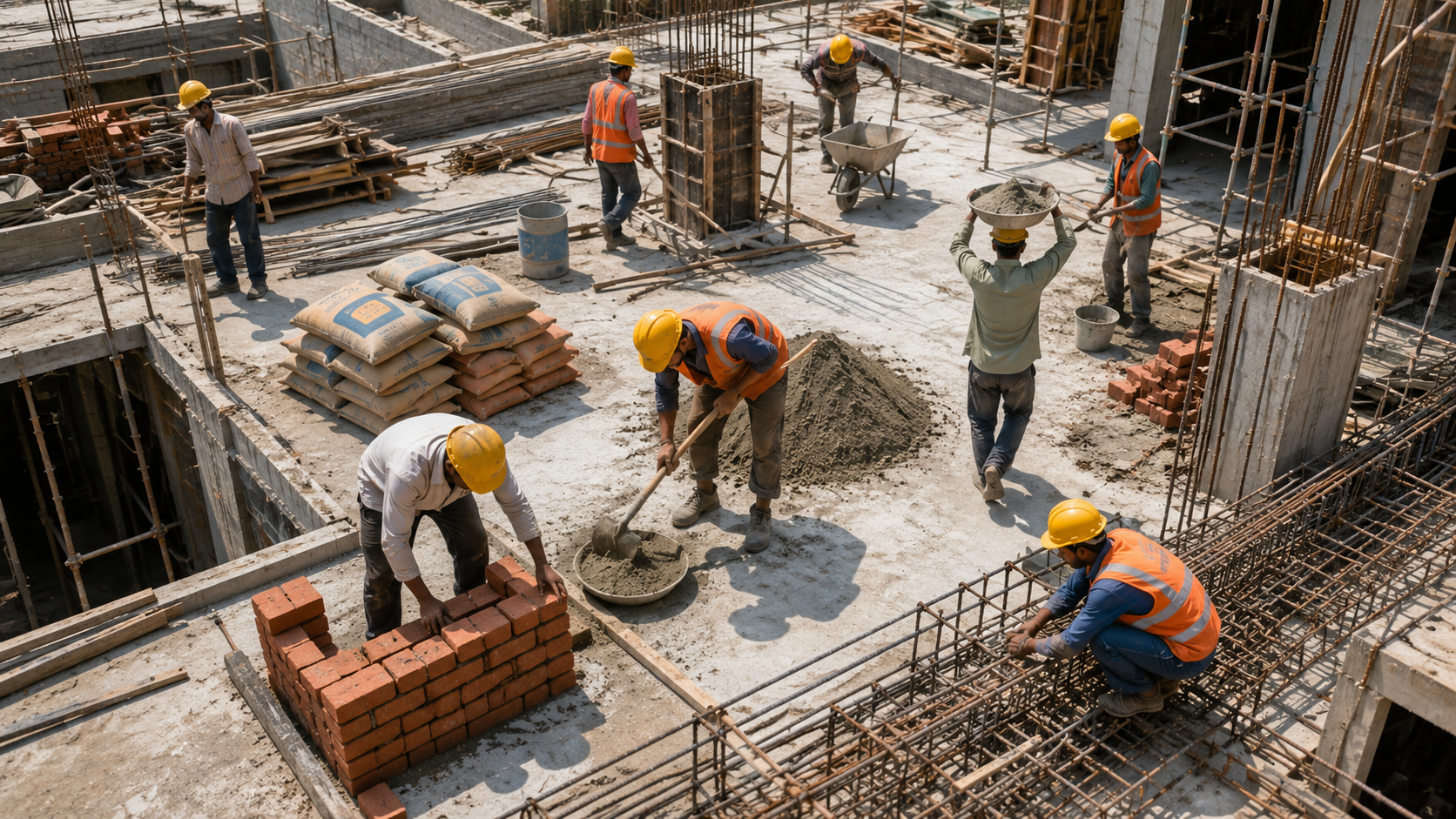
1. Understanding Concrete Mix Ratios: The Basics
A concrete mix ratio refers to the precise volumetric or weigh-based proportion of binding agents (cement), fine aggregates (sand / M-sand), coarse aggregates (crushed granite stone or gravel), and water used to create structural concrete.
The ratio determines the compressive strength, impermeability, and workability of the final hardened product. In Indian standard engineering practice, concrete mix ratios are typically expressed as cement : fine aggregate : coarse aggregate, such as 1:2:4 or 1:1.5:3.
Build cost · Bengaluru, May 2026
Why Mix Ratios Matter
Structural Integrity: Proper proportions provide the exact characteristic compressive strength ($f_{ck}$) required for different structural members (footings, columns, beams, and slabs).
Durability & Permeability: Correct grading minimizes capillary voids, protecting internal steel rebar against carbonation and corrosion.
Cost Efficiency: Avoiding unnecessary cement over-dosage reduces material costs without compromising mandatory safety thresholds.
Workability & Placement: Balanced mixes ensure smooth placement, pumpability, and easy compaction around congested steel reinforcement cages.
Reduced Shrinkage: Well-graded aggregates minimize thermal cracking and plastic shrinkage during the initial curing phase. Material Quantities Calculation for 1 $m^3$ of M20 Concrete
Because dry materials compact when water is added, a factor of 1.54 is applied to convert wet concrete volume into dry volume requirement:
$$\text{Dry Volume} = 1 \text{ m}^3 \times 1.54 = 1.54 \text{ m}^3$$
For M20 Concrete (1 : 1.5 : 3), total proportion parts = $1 + 1.5 + 3 = 5.5$.
Cement Volume: $(1 / 5.5) \times 1.54 = 0.28 \text{ m}^3$
Bags Required: $0.28 / 0.0347 \text{ m}^3/\text{bag} = \mathbf{8.07 \text{ bags}}$ (approx. 8 bags per $m^3$).
Fine Aggregate (M-Sand): $(1.5 / 5.5) \times 1.54 = 0.42 \text{ m}^3 \approx \mathbf{14.83 \text{ cu. ft.}}$ (cft).
Coarse Aggregate (20mm & 10mm): $(3 / 5.5) \times 1.54 = 0.84 \text{ m}^3 \approx \mathbf{29.66 \text{ cu. ft.}}$ (cft).
Water Content: Water-cement ratio of $0.45 \text{ to } 0.50$ requires approx. 170 – 190 Liters per $m^3$.
Environmental & Regional Exposure Specifications (IS 456 Compliance)
To prevent structural failure, concrete durability specifications must adjust based on regional exposure:
Coastal & Marine Regions (Severe Exposure): Minimum concrete grade is M30 for RCC, with a maximum water-cement ratio of 0.45 and minimum cement content of 320 $kg/m^3$ to resist chloride ion penetration and steel corrosion.
Inland Hot & Dry Regions (Moderate Exposure): Minimum grade M20 for RCC, maintaining a water-cement ratio between 0.45 and 0.50. Polypropylene fiber additives (0.6–0.9 kg/$m^3$) are recommended to prevent plastic shrinkage cracking during high-temperature casting.
Monsoon Regions: Use mineral admixtures such as Fly Ash (15–25%) or Ground Granulated Blast-Furnace Slag (GGBS) to reduce heat of hydration and micro-cracking during humid curing conditions.
2. Classification of Concrete Mixes: Nominal vs. Design Mix
Under IS 456:2000 (Indian Standard Code of Practice for Plain and Reinforced Concrete), concrete mixes are categorized into two primary types:
Frequently asked
A. Nominal Mixes (M10 to M20)
For small-scale residential or minor structures where preliminary laboratory testing is impractical, nominal mixes specify fixed volume proportions of ingredients. However, as per modern BIS revisions, nominal mixes carry higher safety factors and are strictly restricted to minor, non-critical works (e.g., boundary walls, PCC sub-bases, pathways).
B. Standard and High-Strength Design Mixes (M25 and Above)
For all engineered framed structures, high-rises, and commercial complexes, Design Mixes are legally and technically mandatory. Here, proportions are established via rigorous laboratory trials based on local material specific gravities, silt content, aggregate fineness modulus, and exposure conditions.
Standard Concrete Grades in India At-a-Glance
Mix Grade | Nominal Proportions | Characteristic Strength (28-day) | Primary Field Usage |
|---|---|---|---|
M10 | 1 : 3 : 6 | 10 MPa () | PCC Bedding, Blinding Layers |
M15 | 1 : 2 : 4 | 15 MPa () | Pathways, Floor Beds, Compound Walls |
M20 | 1 : 1.5 : 3 | 20 MPa () | G+2 Residential Slabs, Beams, Columns |
M25 | 1 : 1 : 2 | 25 MPa () | High-Rises, Structural Columns, Retaining Walls |
M30+ | Design Mix | 30+ MPa () | Seismic Zones, Deep Bored Piles, Heavy Infrastructure |
A. 1:3:6 Mix Ratio (M10 Grade)
Proportions: 1 Part Cement : 3 Parts Sand : 6 Parts Coarse Aggregate.
Compressive Strength: $10 \text{ MPa}$ at 28 days.
Primary Uses: Plain Cement Concrete (PCC) foundation sub-beds, damp-proof course (DPC) layers, flooring underlays, and non-load-bearing mass concrete works.
Estimated Market Cost in India: Approximately ₹150 – ₹190 per cubic foot / ₹5,300 – ₹6,700 per cubic meter.
B. 1:2:4 Mix Ratio (M15 Grade)
Proportions: 1 Part Cement : 2 Parts Sand : 4 Parts Coarse Aggregate.
Compressive Strength: $15 \text{ MPa}$ at 28 days.
Primary Uses: Non-structural elements, boundary compound walls, light paving, mass footings for single-story structures, and rigid pavement sub-bases.
Estimated Market Cost in India: Approximately ₹180 – ₹230 per cubic foot / ₹6,300 – ₹8,100 per cubic meter.
C. 1:1.5:3 Mix Ratio (M20 Grade)
Proportions: 1 Part Cement : 1.5 Parts Sand : 3 Parts Coarse Aggregate.
Compressive Strength: $20 \text{ MPa}$ at 28 days.
Primary Uses: The benchmark mix for residential framed buildings up to G+2 floors across urban centers (Delhi, Pune, Hyderabad, Bangalore). Ideal for columns, beams, suspended floor slabs, and staircases.
Estimated Market Cost in India: Approximately ₹220 – ₹290 per cubic foot / ₹7,700 – ₹10,200 per cubic meter.
D. 1:1:2 Mix Ratio (M25 Grade)
Proportions: 1 Part Cement : 1 Part Sand : 2 Parts Coarse Aggregate.
Compressive Strength: $25 \text{ MPa}$ at 28 days.
Primary Uses: High-rise residential towers, heavy commercial structures, coastal buildings exposed to saline spray, industrial shop floors, retaining walls, and water-retaining reservoirs.
Estimated Market Cost in India: Approximately ₹280 – ₹360 per cubic foot / ₹9,800 – ₹12,700 per cubic meter.
E. M30 Grade and Above (Design Mixes)
Proportions: Determined via laboratory trial mixes (typically richer cement content with supplementary mineral admixtures).
Compressive Strength: $30 \text{ MPa}$ to $60+ \text{ MPa}$.
Primary Uses: High-rise structural shear walls, deep bored pile foundations, earthquake-resistant frames in seismic zones IV and V, bridge girders, and precast structural elements.
Estimated Market Cost in India: ₹350 – ₹500+ per cubic foot depending on admixture and pumping requirements.
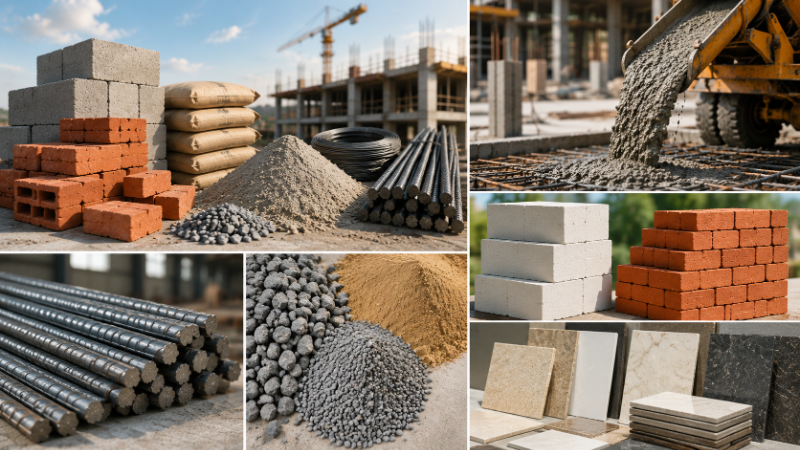
4. Critical Factors Affecting Concrete Mix Design
A. Climate and Environmental Exposure Conditions
India's diverse micro-climates place extreme demands on structural concrete:
Coastal & Marine Zones (Mumbai, Chennai, Kochi, Visakhapatnam): High chloride and sulfate concentration requires M25/M30 minimum mixes, lower water-cement ratios, protective epoxy-coated rebar, and Sulphate-Resisting Cement (SRC) or slag cements.
Arid & High-Temperature Zones (Rajasthan, parts of Gujarat & interior Maharashtra): Rapid evaporation rates cause plastic shrinkage cracking. Requires retarder admixtures, night-time pouring schedules, and aggressive continuous curing.
Heavy Monsoon Belts (Western Ghats, Northeast India): High ambient moisture necessitates strict moisture-content adjustments for stockpiled sand and aggregates.
B. Water-Cement (W/C) Ratio Control
The water-cement ratio is the most vital parameter governing concrete strength. A lower W/C ratio increases compressive strength and reduces permeability, but compromises workability if mismanaged.
M15 Mix: W/C Ratio of $0.60 - 0.70$
M20 Mix: W/C Ratio of $0.55 - 0.60$
M25 Mix: W/C Ratio of $0.50 - 0.55$
M30 and Above: W/C Ratio of $0.45 - 0.50$
Critical Engineering Rule: Every extra liter of unapproved mixing water added on-site reduces final 28-day compressive strength by up to 5% and drastically increases porosity.
C. Aggregate Quality, Grading, and Sand Selection
River Sand (Natural Sand): Traditionally favored for smooth finish and workability, but increasingly restricted due to environmental riverbed mining regulations.
Manufactured Sand (M-Sand): Cubical crushed rock sand (Zone II grading) is now widely mandated across Indian metros (Bangalore, Chennai, Mumbai) for superior structural interlocking and consistent fineness modulus.
Coarse Aggregate: Graded crushed granite or basalt stone chips ($20\text{mm}$ down for general work, $10\text{mm}$ for congested reinforcement beams and columns).
D. Cement Types Available in India
Ordinary Portland Cement (OPC 43 / 53): High early strength, ideal for precast elements and rapid formwork removal.
Portland Pozzolana Cement (PPC): Contains 15–35% fly ash; exhibits lower heat of hydration, resists chemical attack, and improves long-term impermeability. Preferred for general residential construction. Composite Cement (PCC/PSC): Blended cements utilizing blast furnace slag for enhanced durability against marine salts.
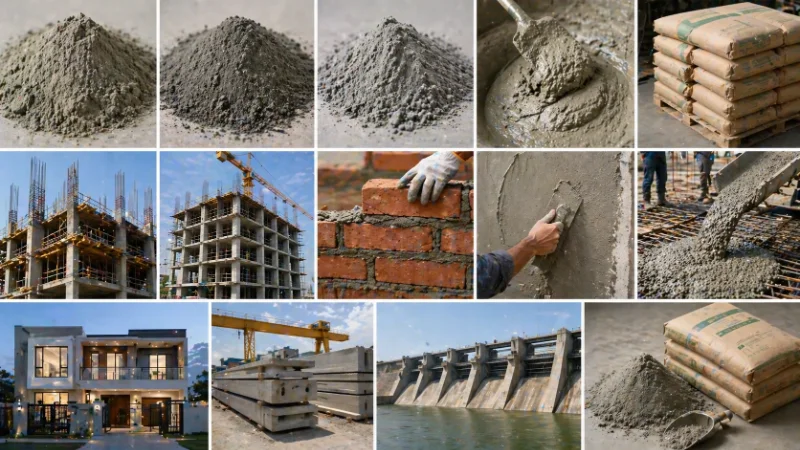
5. Step-by-Step Material Calculation for 1 Cubic Meter of M20 Concrete
To accurately estimate material procurement budgets, site engineers use absolute volume calculations. For 1 cubic meter of wet M20 concrete (1:1.5:3 ratio):
Dry Volume Conversion Factor: Fresh concrete shrinks when compacted; dry ingredients occupy approximately 1.54 times the wet volume ($1 \text{ m}^3 \times 1.54 = 1.54 \text{ m}^3$ of dry materials).
Sum of Proportions: $1 + 1.5 + 3 = 5.5$ parts.
Cement Quantity:$$\text{Volume} = \left(\frac{1}{5.5}\right) \times 1.54 = 0.28 \text{ m}^3$$With cement density at $1440 \text{ kg/m}^3$: $0.28 \times 1440 = 403.2 \text{ kg}$ (Equivalent to 8.06 bags of 50 kg cement).
Fine Aggregate (Sand) Quantity:$$\text{Volume} = \left(\frac{1.5}{5.5}\right) \times 1.54 = 0.42 \text{ m}^3$$Weight ($1.5 \times 1440$ approx bulking adjusted): $\approx 605 \text{ kg}$.
Coarse Aggregate Quantity:$$\text{Volume} = \left(\frac{3}{5.5}\right) \times 1.54 = 0.84 \text{ m}^3$$Weight ($3 \times 1440$): $\approx 1210 \text{ kg}$.
Mixing Water: Approximately $186 \text{ liters}$ (maintaining a $0.45$ to $0.50$ W/C ratio with plasticizer chemical admixtures).
Through platforms like AECORD, project planners can instantly connect with verified material suppliers and ready-mix concrete (RMC) plants to deliver precise batch quantities directly to site.
6. Quality Control, Testing Protocols, and Compliance
To guarantee structural safety and meet statutory Indian building bylaws, strict quality control tests must be conducted during execution:
A. Slump Cone Test (Workability)
Measures the consistency and flowability of fresh concrete.
Standard Slump Values:
Foundations & Mass Concrete: $75\text{mm} - 100\text{mm}$
Columns, Beams & Slabs: $100\text{mm} - 150\text{mm}$
Piled Foundations (Pumping): $150\text{mm} - 175\text{mm}$
B. Compressive Strength Cube Testing
Cast standard $150\text{mm} \times 150\text{mm} \times 150\text{mm}$ steel mold cubes from pouring batches.
Cure in clean water tanks and test in certified compression testing machines (CTM) at 7 days (should achieve ~65% of target strength) and 28 days (must achieve 100% characteristic compressive strength $f_{ck}$).
C. Statutory IS Code Adherence
All structural concrete works must comply strictly with IS 456:2000, IS 10262 (Guidelines for Concrete Mix Design Proportioning), and IS 383 (Specifications for Coarse and Fine Aggregates from Natural Sources).
7. Common Mistakes in Concrete Mix Design on Indian Sites
Uncontrolled Water Addition: Allowing laborers to add water freely for easy placement, severely destroying concrete matrix bonding.
Neglecting Silt Content in Sand: Using river sand containing over 5% silt/clay without washing, which reduces bond strength between cement paste and aggregate.
Inadequate Curing Durations: Stopping curing after 3 to 5 days instead of the mandatory minimum 10 to 14 days required for proper cement hydration, leading to surface dusting and cracking.
Ignoring Formwork Stripping Times: Removing column shutters before 24 hours and slab bottom props before 14 to 21 days, risking structural sagging and shear cracking.
8. Sustainable Concrete Mix Design & Modern Innovations
With tightening environmental regulations across Indian metropolitan hubs (Bangalore, Pune, Mumbai, Delhi-NCR), sustainable construction practices are redefining mix designs:
Fly Ash & GGBS Substitution: Replacing 20% to 35% of Portland cement with industrial byproduct fly ash reduces carbon emissions, lowers hydration heat, and boosts long-term durability.
Recycled Concrete Aggregates (RCA): Crushed demolition waste utilized for non-structural sub-bases and barrier walls.
Self-Compacting Concrete (SCC): High-performance fluid concrete that flows and consolidates under its own weight without mechanical vibration, ideal for densely reinforced modern architectural columns.
9. Frequently Asked Questions (FAQs)
Q: What is the minimum concrete grade allowed for residential RCC works in India?
A: According to IS 456:2000, M20 (1:1.5:3) is the minimum permissible grade for all Reinforced Cement Concrete (RCC) elements such as columns, beams, slabs, and footings.
Q: Is M-Sand a viable replacement for natural river sand in concrete mix?
A: Yes. Manufactured Sand (M-Sand) meeting Zone II grading specifications (IS 383:2016) provides superior compressive strength, eliminates silt impurities, and is the standard industry recommendation across India.
Q: Why is M25 concrete considered a design mix rather than a nominal mix?
A: IS 456 mandates that concrete of M25 grade and above should be designed through laboratory trial mixes (per IS 10262) to optimize cement consumption, workability, and target strength based on aggregate quality.
Conclusion
Mastering concrete mix ratios is the absolute foundation of durable, safe, and cost-effective construction in India. Whether executing a small residential independent home or managing a large commercial development, selecting the correct grade—such as M15, M20, or M25—maintaining strict water-cement ratios, performing rigorous cube testing, and ensuring proper curing are non-negotiable practices.
To source certified building materials, hire experienced structural engineers, or connect with verified ready-mix concrete suppliers across India, explore the professional network on AECORD. Build with precision, adhere to BIS standards, and safeguard your structural investments for generations to come.