

Executive Summary
Commercial swimming pool construction—spanning luxury hotels, residential high-rise housing societies, water parks, wellness clubs, and Olympic-grade sports complexes—demands rigorous structural engineering, adherence to public health safety guidelines, and heavy-duty mechanical filtration systems. In August 2026, asset owners and project developers face a shifting regulatory and cost landscape driven by advanced water-conservation mandates and rising material specifications.
This guide provides an end-to-end blueprint for commercial pool projects in India, breaking down capital expenditure, structural types, regulatory compliance, operational maintenance, and capital return timelines.
Build cost · Bengaluru, May 2026
1. Commercial Swimming Pool Construction Costs (2026 Benchmarks)
Commercial pools differ fundamentally from residential variants due to heavier bather loads, continuous filtration cycles, and strict municipal safety codes. Below are the estimated capital expenditure benchmarks for 2026:
Commercial Project Type | Standard Size / Capacity | Approximate Cost Range (INR) | Primary Engineering Focus |
Boutique Hotel / Resort Pool | 40 × 20 ft (Medium Lap / Leisure) | ₹40 Lakh – ₹85 Lakh | Aesthetic infinity edges, mood lighting, high-end tiling |
Gated Community / Society Pool | 60 × 30 ft (Multi-family standard) | ₹70 Lakh – ₹1.5 Crore | Heavy-duty surge tanks, children's wading zones, durability |
Commercial Club / Olympic Training | 50 × 25 meters (Competition Grade) | ₹2.5 Crore – ₹5.5 Crore+ | FINA compliance, starting blocks, commercial filtration grids |
Water Park / Leisure Complex | Custom multi-basin layout | ₹3.0 Crore – ₹10 Crore+ | Wave generators, slide towers, automated chemical dosing |
2. Detailed Cost Breakdown by Component
Executing a commercial pool requires allocating capital across civil, mechanical, and finishing categories:
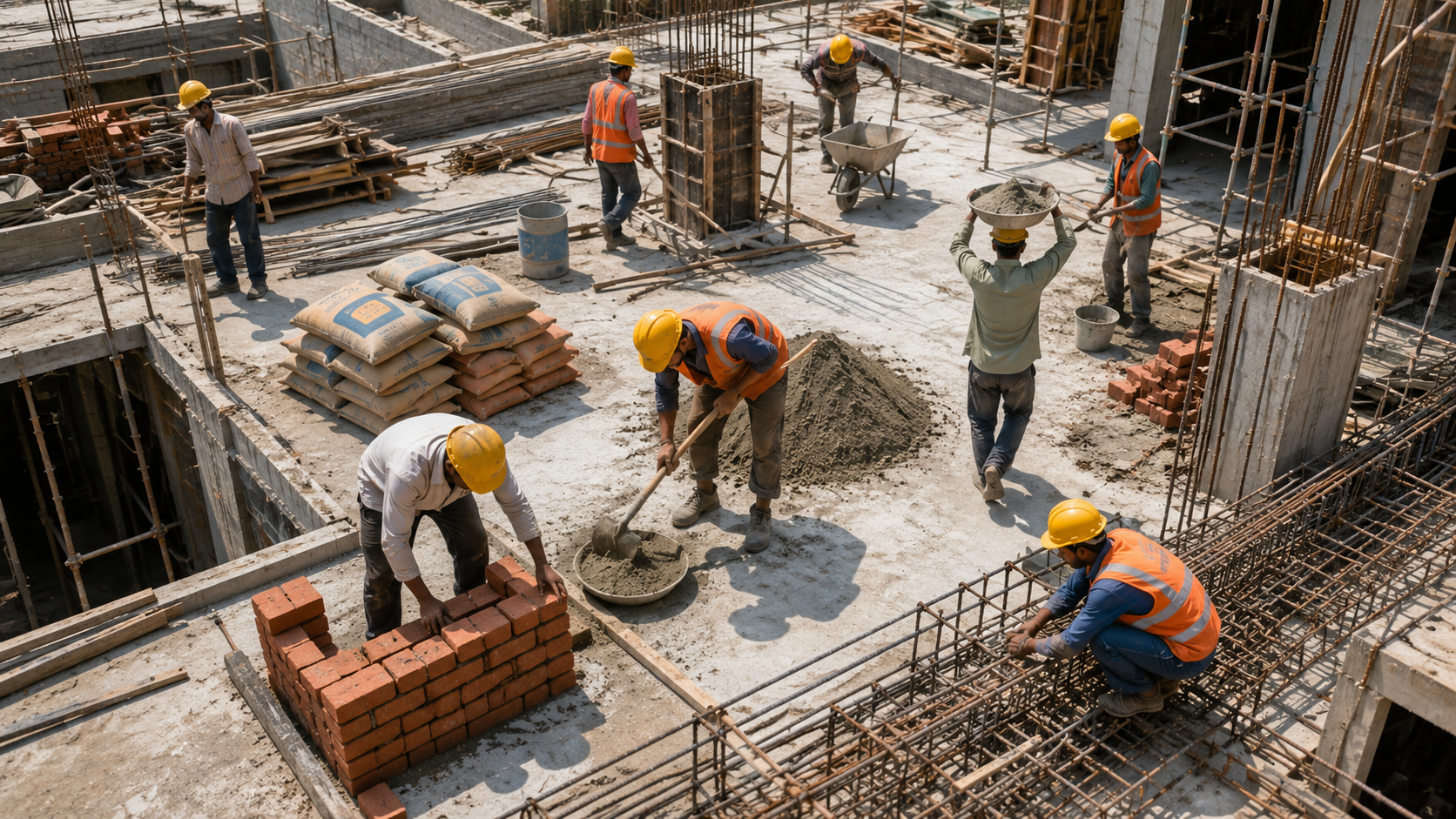
Civil Works & Excavation (35% - 40%): Earthwork, RCC (Reinforced Cement Concrete) framing, structural waterproofing, guniting, and structural testing.
Filtration & Circulation Equipment (25% - 30%): Commercial-grade sand/multimedia filters, high-flow centrifugal pumps, automatic chemical controllers, UV disinfection systems, and surge tanks.
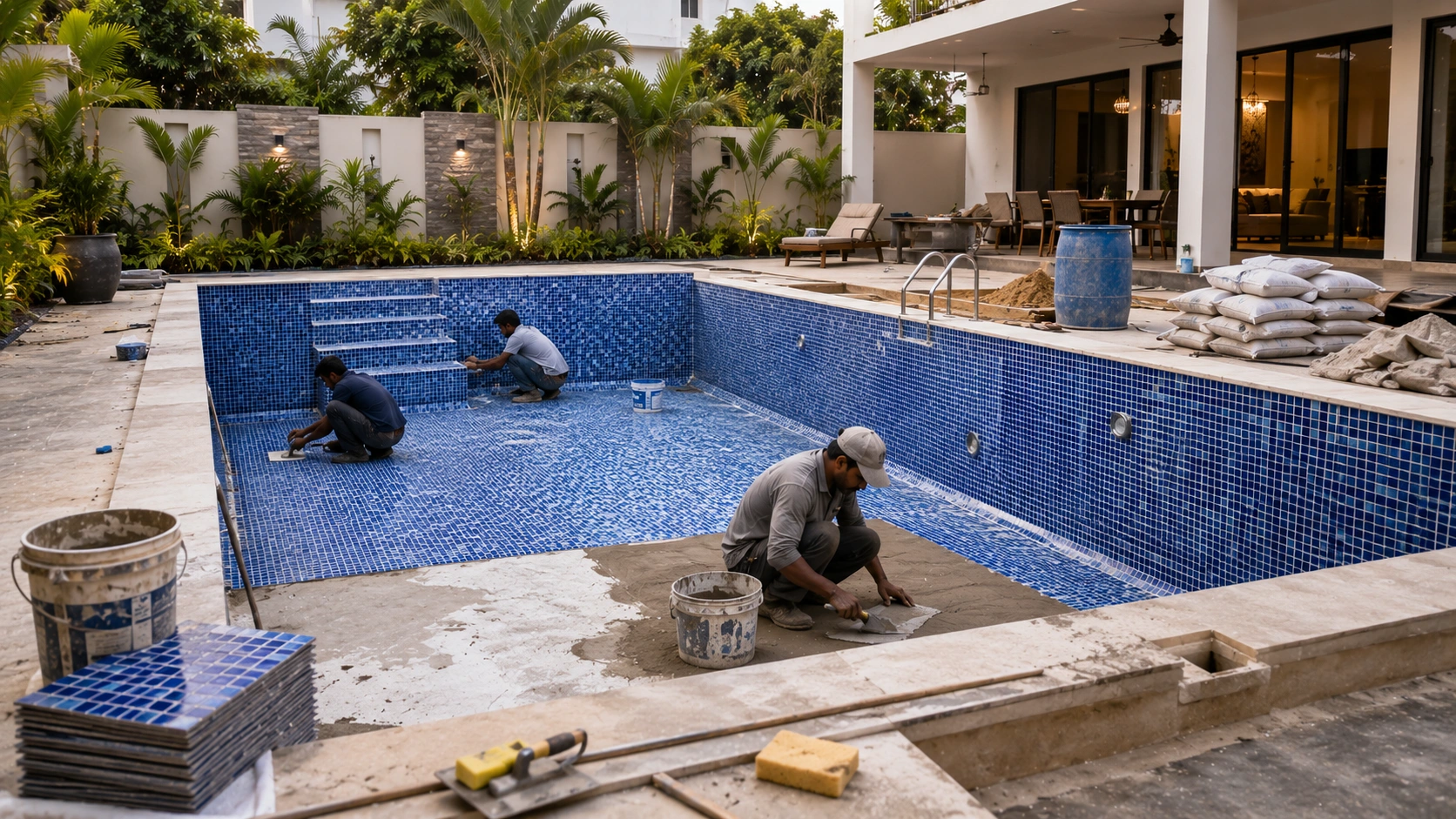
Finishing & Tiling (15% - 20%): Anti-skid ceramic/glass mosaic pool tiles, coping stones, underwater LED lighting grids, and lane markings.
Decking, Safety & Ancillaries (10% - 15%): Perimeter drainage channels, safety ladders, lifeguard stands, perimeter fencing, and pump house enclosures.
3. Regulatory Compliance & Indian Safety Standards
Commercial pools in India must comply with local municipal bye-laws, environmental clearances, and public health codes:
Water Conservation & Ground Water Rules: Central Ground Water Board (CGWB) guidelines and state municipal bodies (such as BMC, BWSSB, and DJB) mandate zero raw water wastage, strict backwash recycling, and mandatory rainwater harvesting integration around the facility.
Public Health & Hygiene (BIS Standards): Water quality must align with Bureau of Indian Standards (BIS) specifications, ensuring free chlorine residual levels ($1.0\text{ ppm}$ to $3.0\text{ ppm}$) and automated pH balancing ($7.2$ to $7.6$).
Structural Safety Certification: Every commercial pool requires structural stability sign-offs by licensed structural engineers, incorporating seismic zone reinforcement and dynamic load calculations for deck areas.
Fire & Emergency Access: Proper clearances for fire tenders around high-rise residential or hotel podium pools as per National Building Code (NBC) norms.
Frequently asked
4. Engineering Comparison: Construction Types for Commercial Use
Material / Method | Durability & Lifespan | Maintenance Overhead | Best Suited For Indian Climate |
Reinforced Concrete (RCC) | 50+ Years | Moderate (requires periodic acid washing and grout check) | Industry Gold Standard for all high-traffic commercial spaces |
Modular Stainless Steel Systems | 30–40 Years | Very Low (resistant to seismic shifts and cracking) | Seismic zones, podium and terrace installations |
Gunite / Shotcrete Pools | 40–50 Years | Moderate | Custom-shaped resort pools and freeform leisure setups |
5. Real-World Case Studies in India
Case Study 1: 5-Star Hotel Rooftop Pool in Mumbai
Scope: 45 × 18 ft infinity edge pool on a 15th-floor reinforced podium.
Execution: Utilized a lightweight modular stainless steel framework to minimize dead load, paired with variable-frequency drive (VFD) pumps and automatic UV sterilizers.
Total Project Cost: ₹92 Lakh | Timeline: 110 Days.
Case Study 2: Gated Community Clubhouse Pool in Bengaluru
Scope: Dual-basin setup (Main pool 75 × 35 ft + Toddler pool) with underground RCC surge tank.
Execution: Heavy-duty commercial quartz filtration system with automated chlorine dosing to handle peak weekend bather loads of 200+ residents.
Total Project Cost: ₹1.45 Crore | Timeline: 140 Days.
6. Leading Equipment Brands & Suppliers in India
Sourcing high-grade equipment ensures longevity and minimizes downtime. Prominent global and domestic brands supplying the Indian commercial market include:
Pentair & Hayward: Industry leaders in commercial pumps, high-capacity sand filters, and LED lighting systems.
Emaux & Astral Pool: Widely specified for commercial fittings, main drains, skimmers, and chemical automation controllers.
Grundfos: Preferred supplier for heavy-duty commercial booster and recirculation water pumps.
7. Operational ROI & Payback for Commercial Operators
For hotels, clubs, and sports academies, a well-designed commercial pool functions as a core revenue driver:
Leasing & Membership Value: Premium amenities boost hotel room nightly rates by 15–25% and drive residential society maintenance fee evaluations.
Energy Optimization: Integrating VFD pumps, solar pool heating blankets, and automated backwash water recycling systems reduces monthly electricity and water utility expenses by 35% to 50%, accelerating operational breakeven within 3 to 5 years.
Timeline and Cost Considerations
Project Timeline
A typical commercial swimming pool project timeline includes:
Planning and approvals: 3-6 months
Structural construction: 4-6 months
MEP (Mechanical, Electrical, Plumbing) installation: 2-3 months
Finishing and testing: 1-2 months
Total duration: 10-17 months
Monsoon seasons can extend timelines. Projects in coastal areas or regions with heavy rainfall should plan for 2-3 month delays. Securing environmental clearances and multiple permits can add 2-4 months to pre-construction timelines.
Cost Breakdown
For a typical 50m x 25m commercial pool in an Indian metro:
Structural work: 35-40%
Waterproofing and finishes: 15-20%
Mechanical and filtration systems: 15-20%
Electrical and controls: 10-12%
Safety systems and equipment: 5-8%
Landscaping and miscellaneous: 5-10%
Contingency budgets of 10-15% are standard practice given India's construction variables.
Operational Considerations
Maintenance and Management
Post-construction, ongoing maintenance is critical. Annual maintenance costs typically run 8-12% of capital investment. Key maintenance areas include:
Equipment servicing and replacement
Chemical supplies and water treatment
Staff training and certification
Insurance and regulatory compliance
Structural inspections and repairs
Establishing relationships with experienced pool maintenance contractors early ensures smooth operations. Many facilities in India partner with specialized companies for technical support.
Staffing Requirements
A commercial pool requires trained personnel including pool operators, lifeguards, and maintenance staff. Budget for recruitment, training, and ongoing professional development. Certification programs through organizations like the Indian Red Cross Society are essential for lifeguards.
Choosing the Right Construction Partner
The success of your commercial pool project depends significantly on selecting experienced professionals. Look for contractors, architects, and engineers with proven track records in aquatic facility construction. Verify their experience with BIS compliance, waterproofing solutions, and mechanical systems specific to Indian conditions.
When evaluating potential partners, request references from completed projects, verify their understanding of local regulations, and ensure they have relationships with reliable suppliers for specialized equipment like filtration systems and chemical dosing units.
On AECORD, India's leading B2B2C marketplace for AECO professionals, you can connect with verified architects, engineers, contractors, and specialized service providers experienced in commercial pool construction. AECORD's platform makes it easy to compare qualifications, review portfolios, and find professionals who understand the specific requirements of commercial swimming pool projects in your region.
Conclusion
Commercial swimming pool construction in India is a complex undertaking requiring expertise across multiple disciplines. From initial planning through operation, success depends on understanding regulatory requirements, selecting appropriate technologies, and partnering with experienced professionals. By following this comprehensive guide and engaging qualified experts, you can create a world-class aquatic facility that serves your community safely and sustainably.
Whether you're in Delhi, Mumbai, Bangalore, or any other Indian city, the fundamentals remain consistent: rigorous planning, quality materials, expert execution, and ongoing maintenance. Start your project journey by connecting with experienced professionals on AECORD who understand commercial pool construction in the Indian market. Browse portfolios, compare expertise, and find the right team to bring your aquatic facility vision to life.
Frequently Asked Questions (FAQ)
What are the main regulatory requirements for operating a commercial swimming pool in India?
Operators must secure municipal trade licenses, adhere to state pollution control board guidelines for wastewater discharge, maintain daily logbooks for chemical dosing parameters (chlorine/pH), and obtain structural safety clearances from licensed structural engineers.
How often does a commercial pool water need complete replacement?
With modern continuous turnover filtration systems (complete water turnover every 4 to 6 hours) and automated UV/chlorine sanitation, complete water draining is typically required only once every 12 to 24 months for structural maintenance, while daily makeup water is added to offset evaporation and backwashing.
Why are commercial pools significantly more expensive than residential pools?
Commercial pools must withstand heavy bather loads, meet stringent public health safety standards, incorporate fail-safe backup circulation pumps, and utilize commercial-grade surge tanks and automated chemical controllers to prevent contamination.