

White cement has evolved from a niche specialty additive into a foundational material for modern architectural and structural engineering across India. For construction professionals, architects, contractors, and large-scale developers, specifying the right white cement is critical to achieving superior aesthetic finishes, long-term durability, and structural integrity.
Among market options, Birla White Cement 50 kg remains the benchmark choice.Manufactured in compliance with Indian Standards IS 12600:2018, it delivers exceptional whiteness (exceeding 89%–95% Hunter whiteness), high early strength, and refined workability.
This comprehensive guide covers updated 2026 market pricing, exact technical specifications, mix designs, comparison frameworks against grey cement, and sourcing strategies via digital supply ecosystems like AECORD.
What is Birla White Cement? Composition and Manufacturing Excellence
Unlike ordinary Portland cement (OPC), which derives its characteristic grey hue from iron oxide and magnesium oxide compounds, white cement undergoes a rigorously controlled manufacturing process designed to eliminate color-imparting elements.
Build cost · Bengaluru, May 2026
The Manufacturing Process
Raw Material Selection: High-purity, low-iron limestone and china clay (kaolin) are selected to ensure near-zero iron and manganese contamination.
Controlled Calcination: Kiln temperatures and fuel sources are tightly regulated using advanced precalciner technology, preventing ash or carbon absorption that could dull the pristine white output.
Quick Quenching & Fine Grinding: The clinker is rapidly cooled to stabilize crystal phases, then milled to ultra-fine particle sizes (Blaine fineness of 370–400 m²/kg), securing a high refractive index and smooth finishing capacity.
Technical Specifications and Compliance Matrix (IS 12600:2018)
Engineers require strict adherence to regulatory benchmarks. Birla White Cement meets or exceeds all structural requirements outlined under IS 12600:2018 for white Portland cement:
+-----------------------------------+----------------------------------------+
| Technical Property | Specification Standard / Value |
+-----------------------------------+----------------------------------------+
| Hunter Whiteness | 89% to 95%+ |
| Compressive Strength (3-Day) | Minimum 23.0 MPa |
| Compressive Strength (28-Day) | Minimum 43.0 to 60.0 MPa |
| Blaine Fineness | 370 to 400 m²/kg |
| Initial Setting Time | 45 to 600 minutes |
| Final Setting Time | Maximum 10 hours (600 minutes) |
| Soundness (Le Chatelier Expansion)| Maximum 10 mm |
| Insoluble Residue | Maximum 1.5% |
| Standard Bag Weight | 50 kg (Bulk density: ~1350-1400 kg/m³) |
+-----------------------------------+----------------------------------------+
2026 Pricing and Cost Analysis Across Indian Markets
Fluctuations in energy costs, transportation tariffs, and raw material inputs influence regional pricing. Across major urban centers and tier-2/tier-3 construction hubs, the baseline pricing for an authentic Birla White Cement 50 kg bag (inclusive of applicable GST rates ranging from 28%) spans predictable ranges:
Tier-1 Metropolitan Areas (Mumbai, Delhi, Bengaluru, Chennai, Hyderabad): ₹850 to ₹1,250 per 50 kg bag, depending on distributor tier and delivery distance.
Tier-2 Cities (Pune, Ahmedabad, Jaipur, Lucknow, Coimbatore): ₹700 to ₹960 per 50 kg bag.
Bulk B2B Procurement (100+ bags): Direct project orders typically command a 10% to 15% wholesale discount through structured B2B channels like AECORD.
Frequently asked
Cost Comparison: White Cement vs. Grey Cement
While standard grey cement ranges between ₹350 and ₹450 per 50 kg bag, white cement commands a 2x to 3x premium. However, when deployed strategically for architectural facades, premium tile grouting, and high-end interiors, it accounts for only 2% to 4% of total structural material budgets while exponentially increasing aesthetic property valuation.
Comprehensive Application Guide by Project Type
1. Architectural and Decorative Finishes
Exposed Concrete Façades: Provides a clean, monolithic aesthetic for modern institutional and commercial structures.
Terrazzo and Mosaic Flooring: Serves as the pristine binder base for colored marble chips and glass aggregates.
Ornamental Castings: Powers precast cornices, Jali screens, and complex structural sculptures.
2. Functional and Structural Applications
Tile Adhesives and Joint Grouting: Offers superior bond strength and resistance to moisture penetration in wet areas.
Swimming Pools & Water Retaining Structures: Resists chemical erosion (including chlorine treatments) while offering high opacity.
Heritage Restoration: Matched precisely with historical lime-and-white mortar compositions for structural retrofitting across heritage zones.
Bulk Pricing, Logistics, and Sourcing Best Practices
Procuring construction materials at scale requires mitigating supply chain vulnerabilities, avoiding counterfeit stock, and managing site logistics:
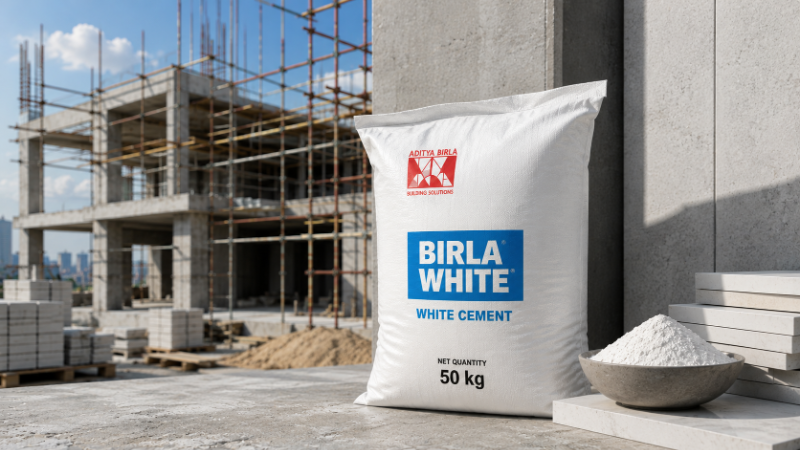
Verify Genuine Packaging: Authentic 50 kg bags feature tamper-proof HDPE sack lining, explicit batch numbering, manufacturing timestamps, and IS certification marks.
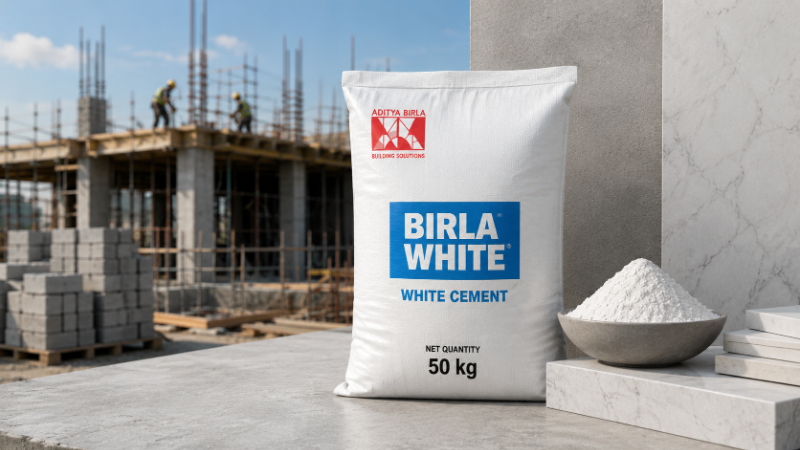
Moisture Control and Storage: White cement is exceptionally hygroscopic. Store bags on raised wooden pallets at least 6 inches off the floor, away from exterior walls, under waterproof covers. Consume stock within 30 to 45 days of delivery.
Streamline Procurement via AECORD: Sourcing through fragmented local vendors often exposes projects to price volatility. Using AECORDallows general contractors and procurement managers to compare verified distributor rates, secure transparent bulk quotes, review supplier performance metrics, and schedule direct-to-site dispatches.
Quality Assurance and Sourcing Best Practices
Identifying Genuine Birla White Cement
The construction industry in India sometimes faces issues with counterfeit or substandard materials. When sourcing Birla White Cement, ensure:
Authentic packaging: Check for proper Birla branding, batch numbers, and manufacturing dates
Authorized dealers: Purchase from authorized distributors and suppliers
Proper documentation: Request quality certificates and test reports
Storage conditions: Verify that bags have been stored in dry conditions away from moisture
Expiry dates: White cement has a shelf life of 3-6 months; verify manufacturing dates
Finding Reliable Suppliers Through AECORD
AECORD, India's leading B2B2C marketplace for AECO professionals, connects construction professionals with verified suppliers of quality materials. Through AECORD's platform, you can:
Compare prices from multiple suppliers across different regions
Access verified supplier profiles with ratings and reviews
Request bulk quotes with transparent pricing
Arrange direct delivery to your project site
Maintain documented procurement records
Using AECORD ensures that you're sourcing authentic Birla White Cement from reliable suppliers, reducing the risk of counterfeit materials and ensuring consistent quality across your projects.
Technical Specifications for Mix Design
Concrete Mix Proportions
For different applications, white cement concrete requires specific mix designs:
Architectural concrete (M40): 1:1.5:3 (Cement:Sand:Aggregate)
Structural concrete (M50): 1:1.2:2.4 (Cement:Sand:Aggregate)
High-strength applications (M60): 1:1:2 (Cement:Sand:Aggregate)
The water-cement ratio typically ranges from 0.45-0.55 depending on the required strength and workability. For decorative applications, finer aggregates and lower water-cement ratios produce superior finishes.
Mortar Specifications for Plastering and Grouting
For plaster and grout applications, typical proportions are:
Plastering mortar: 1:3 to 1:4 (Cement:Sand) for base coats, 1:2 for finish coats
Joint grouting: 1:1 to 1:2 for dense, water-resistant joints
Tile adhesive: 1:2.5 to 1:3 for superior bond strength
Storage, Handling, and Best Practices
Proper Storage Conditions
White cement is more sensitive to moisture than grey cement. Proper storage ensures quality maintenance:
Dry storage: Store in moisture-free, well-ventilated areas
Elevated platforms: Keep bags off the ground to prevent moisture absorption
Weather protection: Use waterproof coverings for outdoor storage
Temperature control: Maintain storage temperature between 5-40°C
Separate storage: Keep white cement away from grey cement to prevent color contamination
First-in-first-out: Use older stock first to prevent expiry
On-Site Handling Recommendations
To maintain quality during construction:
Limit on-site storage duration to 2-3 weeks maximum
Use separate mixing equipment exclusively for white cement
Ensure all equipment is thoroughly cleaned before use
Use clean, dust-free water for mixing
Maintain consistent mixing procedures for uniform color
Complete application within the workability period (typically 2-3 hours)
Environmental and Sustainability Considerations
Modern white cement production has become increasingly sustainable. Birla White Cement manufacturing incorporates:
Energy-efficient kilns: Reducing carbon footprint by 20-30% compared to older facilities
Waste heat recovery: Utilizing thermal energy for power generation
Alternative fuels: Using industrial waste and biomass in production
Raw material optimization: Minimizing quarrying impact through efficient extraction
For environmentally conscious projects in cities like Bangalore and Pune, white cement offers advantages in achieving green building certifications due to its durability and reduced maintenance requirements.
Troubleshooting Common Issues
Color Inconsistency
If you notice color variations between batches:
Verify that all bags are from the same manufacturing batch
Check for contamination in mixing equipment or aggregates
Ensure consistent water quality and quantity in mixes
Use consistent curing methods across all surfaces
Strength Development Problems
If concrete doesn't achieve expected strength:
Verify cement hasn't expired or been improperly stored
Check water-cement ratio compliance
Ensure proper curing procedures (7-14 days minimum)
Test aggregate quality and grading
Conduct compressive strength tests at 7, 14, and 28 days
Cost Optimization Strategies
Bulk Purchasing Benefits
For large projects requiring 500+ bags, consider:
Direct factory purchases: Potential savings of 10-15%
Long-term contracts: Price stability and guaranteed supply
Logistics optimization: Reduced per-unit transportation costs through bulk delivery
Payment terms: Negotiating favorable payment schedules with suppliers
Partial Replacement Strategies
To optimize costs without compromising quality:
Use white cement only for visible surfaces (60-70% of total cement)
Use grey cement for internal structural elements
Apply white cement plaster finish (25-30 mm) over grey concrete base
This approach can reduce white cement consumption by 40-50% while maintaining aesthetic appeal
Connecting with Professionals Through AECORD
Whether you're an architect specifying materials, an engineer designing concrete mixes, or a contractor managing procurement, AECORD provides a comprehensive platform to connect with verified suppliers and professionals. The marketplace allows you to:
Find certified suppliers of Birla White Cement across India
Access technical documentation and product specifications
Request samples before bulk purchases
Manage procurement workflows efficiently
Build long-term supplier relationships
Frequently Asked Questions
What is the coverage area of a 50 kg bag of Birla White Cement?
When used as a neat slurry or thin surface skim coat (2mm to 3mm thickness), a 50 kg bag typically covers approximately 250 to 300 square feet, though coverage varies based on substrate smoothness and application technique.
Can Birla White Cement be tinted with color pigments?
Yes. Because of its exceptional whiteness and neutral color base, it accepts iron oxide and synthetic pigments seamlessly, allowing contractors to produce vibrant, custom-colored architectural renders and floors.
What is the shelf life of an unopened 50 kg bag?
When stored in optimal, moisture-free conditions, the shelf life is 3 to 6 months. Always apply the First-In, First-Out (FIFO) inventory rule on-site.
How does white cement differ structurally from grey cement?
Structurally, white cement performs identically—and often superiorly—to ordinary Portland cement regarding 28-day compressive strength. The primary differences lie in raw material purity, absence of iron/manganese, and whiteness index.
Conclusion
Specifying Birla White Cement 50 kg ensures that commercial and residential projects achieve the ideal intersection of high structural durability and refined architectural presentation.By understanding technical thresholds, optimizing logistics, and leveraging trusted digital procurement platforms like AECORD, construction professionals can safeguard margins and deliver uncompromised build quality.