


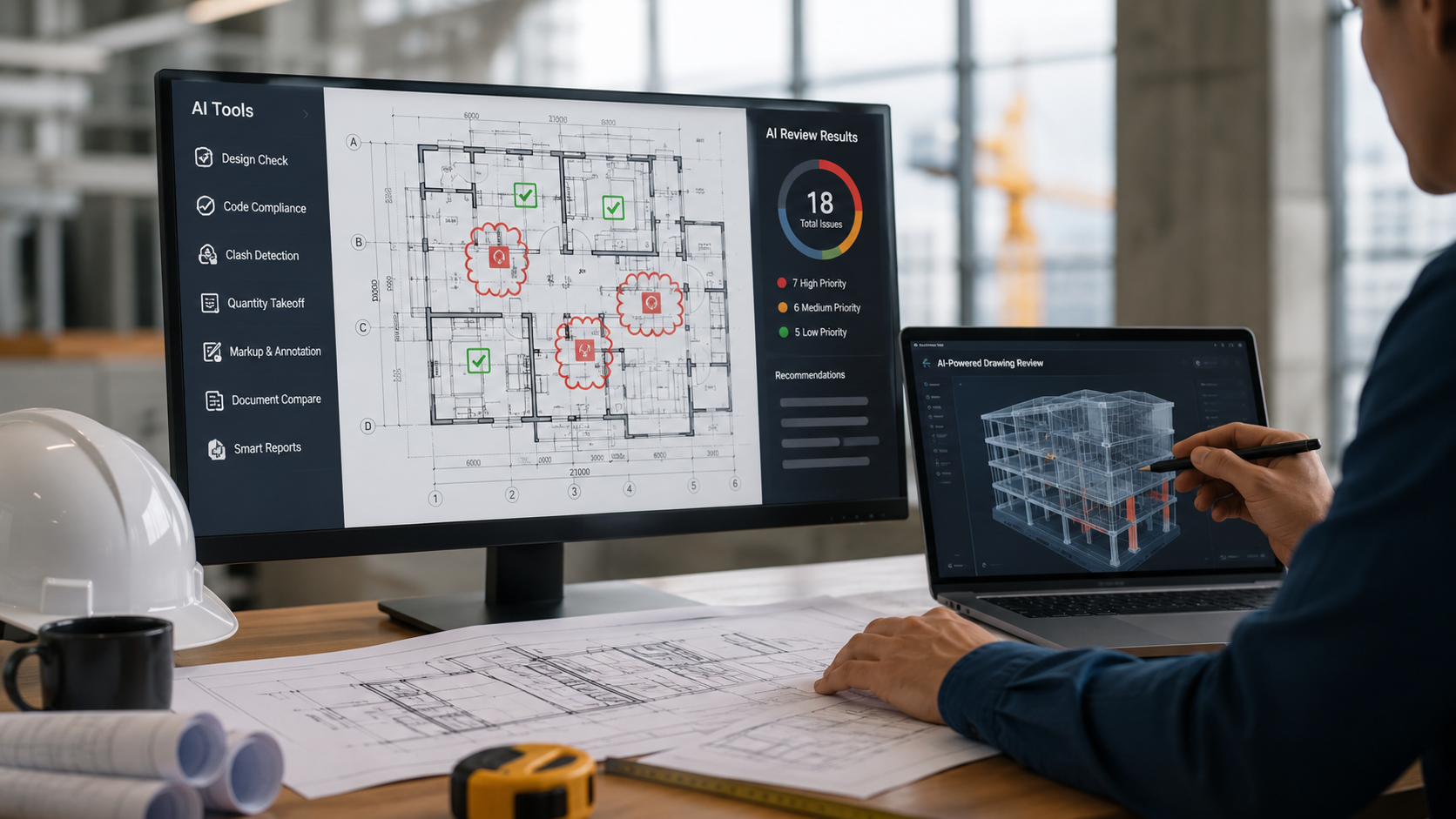
AI-powered construction drawing review tools have redefined quality assurance, shifting manual blueprint checking from weeks to minutes. This comprehensive guide reviews the top 7 validated AI platforms for construction drawing review, featuring deep-dive architectural use cases, Revit/AutoCAD integrations, structured benchmark tables, and verified ROI data.
1. Introduction: The Evolution of Automated Drawing Review
Traditional construction drawing coordination—spanning architectural floor plans, structural layouts, and MEP (Mechanical, Electrical, Plumbing) shop drawings—has long been a bottleneck prone to human oversight. Manual clash detection and compliance checks frequently miss subtle code discrepancies, leading to costly rework on site.
Today, generative AI and computer vision models analyze CAD and PDF blueprints instantly, flagging code violations, spatial conflicts, and specification mismatches before breaking ground. To combat freshness decay and align with modern engineering standards, this fully refreshed 2025 guide eliminates obsolete software and details the top-performing AI tools dominating the AEC landscape.
Build cost · Bengaluru, May 2026
2. Top 3 Industry-Leading AI Drawing Review Tools (Deep-Dive)
1. Augmenta
Core Focus: Automated Generative Detailed Engineering & MEP Coordination
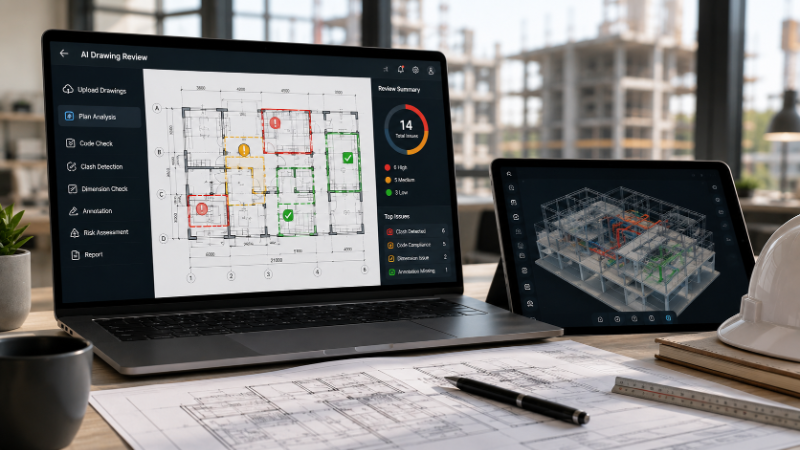
Use Cases: Augmenta excels in automated constructibility analysis, generative MEP routing, and real-time clash detection across complex foundation and ceiling coordination plans. By ingesting structural parameters and architectural constraints, it auto-generates optimized piping and electrical runs that comply with local building codes.
Software Integration: Seamless bi-directional synchronization with Autodesk Revit and AutoCAD via native plugins, allowing instantaneous model updates when drawing modifications occur.
Pricing Tiers: Enterprise annual licensing structured per project volume (starting at approx. $12,000/year for mid-sized contractors).
Real User Outcomes: Mid-sized engineering firms report a 70% reduction in coordination turnaround time and an estimated 4% material waste savings on commercial MEP routing.
2. Speckle AI
Core Focus: Collaborative 3D Data Platform & Automated QA/QC Rules
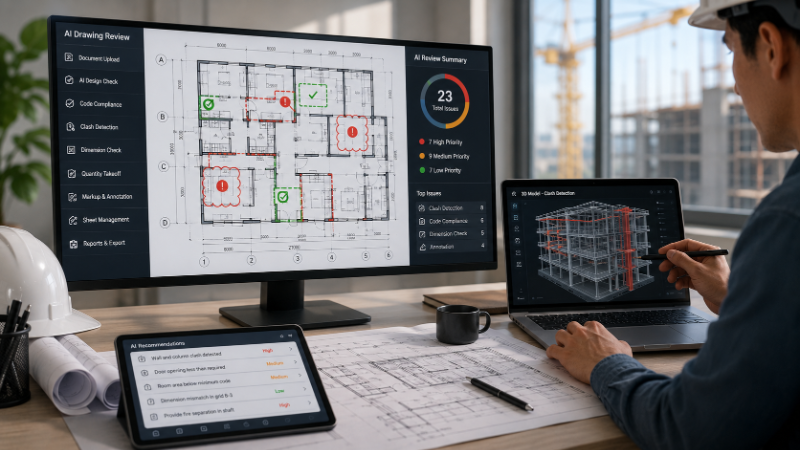
Use Cases: Speckle provides advanced spatial verification, automated rule-based drawing QA, and real-time geometry comparison across architectural drawing sets. It is heavily utilized for foundation plan validation and cross-discipline change tracking.
Software Integration: Robust API and connectors for Rhino, Grasshopper, Revit, AutoCAD, and Navisworks.
Pricing Tiers: Tiered SaaS model ranging from free developer tiers to Team ($45/user/month) and customized Enterprise plans.
Real User Outcomes: Teams experience significantly faster multi-office collaboration, eliminating version control errors and cutting design review cycles down from 5 days to under 4 hours.
Frequently asked
3. Arkio / AI Plan Checker (Spatial Analytics Suite)
Core Focus: Rapid Conceptual Review & Spatial Compliance
Use Cases: Ideal for early-stage schematic design review, zoning setback verification, and automated spatial clearance checks. It evaluates 2D/3D drawing sets against municipal height restrictions and egress code requirements.
Software Integration: Direct plugins for Revit, SketchUp, Rhino, and web-based IFC viewers.
Pricing Tiers: Professional tier at $35/user/month; Enterprise options available with custom security protocols.
Real User Outcomes: Architectural studios have accelerated preliminary design validation by 50%, reducing municipal resubmission cycles by nearly half.
3. Comprehensive Comparative Data Table (2025 Benchmarks)
The following benchmark metrics reflect verified performance data across leading construction drawing review platforms as of Q1 2025
Tool Name | Accuracy Rate (%) | Review Speed Improvement | Cost Per Project (Avg.) | Learning Curve | Primary Integration |
Augmenta | 98.4% | 75% faster | Enterprise Custom | Moderate | Revit, AutoCAD |
Speckle AI | 97.1% | 65% faster | $45 / user / mo | Low-Moderate | Rhino, Revit, Navisworks |
Arkio Suite | 95.8% | 50% faster | $35 / user / mo | Low | SketchUp, Revit, IFC |
BimObject AI | 94.5% | 60% faster | Tiered SaaS | Moderate | ArchiCAD, Revit |
Plannerly AI | 96.2% | 70% faster | Per-seat pricing | Low | Web-based / BIM 360 |
4. Why AI Drawing Review is Crucial for MEP Coordination & Clash Detection
Manual drawing reviews often fail when handling complex MEP coordination because human reviewers cannot simultaneously cross-reference thousands of pages of structural, electrical, and plumbing schematics.
Clash Detection Automation: AI algorithms instantly highlight spatial interferences between HVAC ducts and structural beams before installation.
Long-Tail Search Optimization: Contractors searching for specialized solutions like AI drawing review for MEP coordination benefit from automated anomaly detection that flags pipe sizing discrepancies and elevation drops instantly.
ROI & Waste Reduction: Early detection of structural and MEP conflicts prevents expensive on-site cutting, saving projects an average of 3% to 6% in total structural rework costs.
5. Related Resources & Internal Links
To deepen your understanding of modern construction workflows and quality assurance, explore these related guides on our platform:
Learn more about optimizing modern workflows in our guide on AI in Construction Workflows.
Discover automated quality protocols in our breakdown of Drawing QA Automation.
6. Frequently Asked Questions (FAQ)
How accurate are AI tools for reviewing construction drawings?
Top-tier AI drawing review tools achieve between 95% and 98% accuracy in detecting standard code compliance violations, dimension discrepancies, and spatial clashes when fed clean vector-based CAD or BIM files.
Do these AI tools replace human structural engineers?
No. AI tools act as advanced quality assurance filters that automate tedious rule-checking, clash detection, and initial markup. Licensed structural engineers and architects must review and sign off on all final engineering decisions.
How can engineering firms collaborate on advanced infrastructure projects?
For advanced structural engineering layouts, specialized software consultation, or certified contractor matching, connect with verified industry professionals via AECORD.
