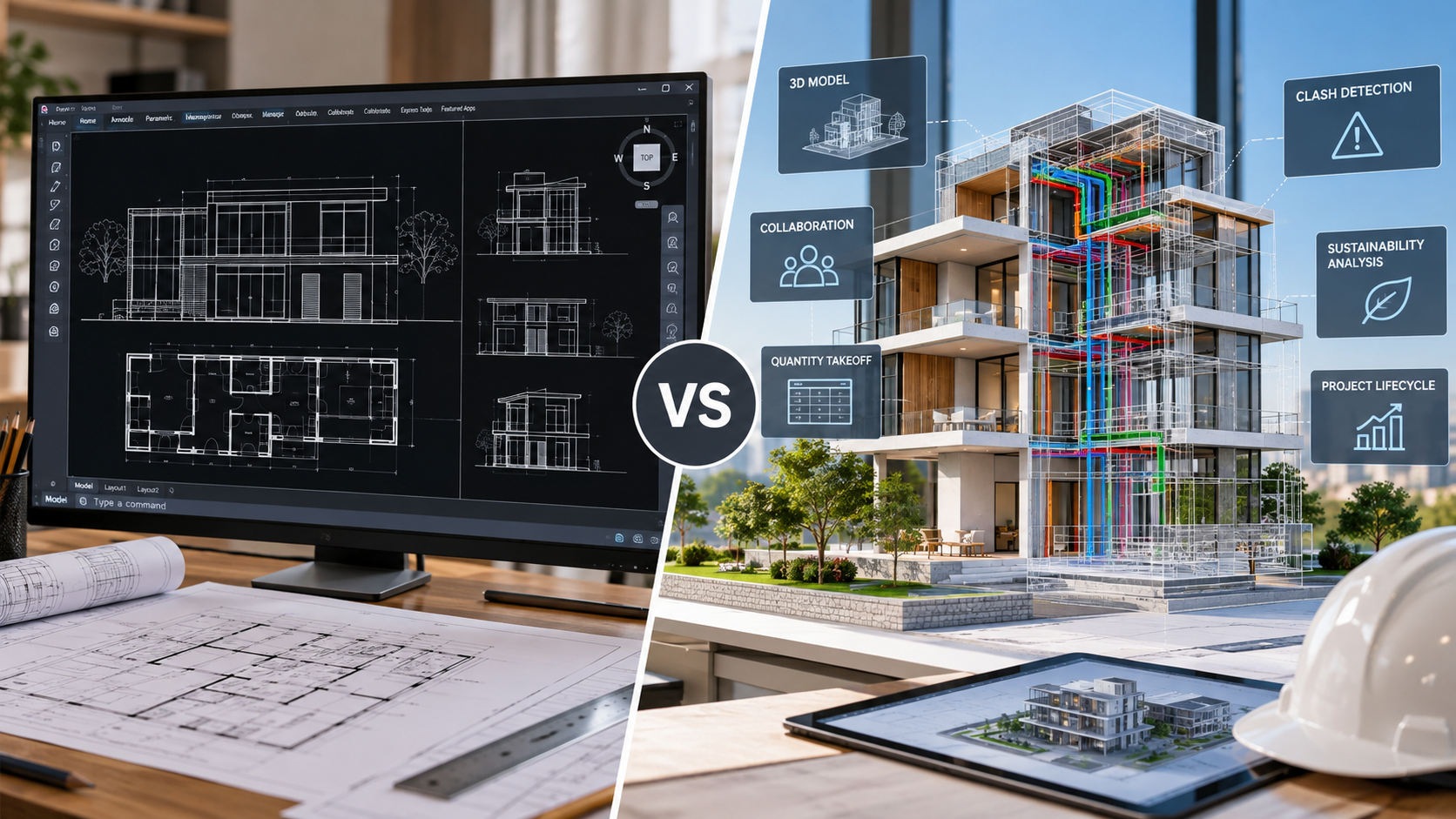


Artificial Intelligence has moved beyond the hype cycle of large language models and transformer architectures. The real transformation happening now is in how AI systems are architected, integrated, and deployed within organizations—particularly in the Architecture, Engineering, Construction, and Operations (AECO) sector across India. This shift from "AI as a tool" to "AI as infrastructure" represents the true next phase of artificial intelligence evolution.
The Evolution from Models to Architecture
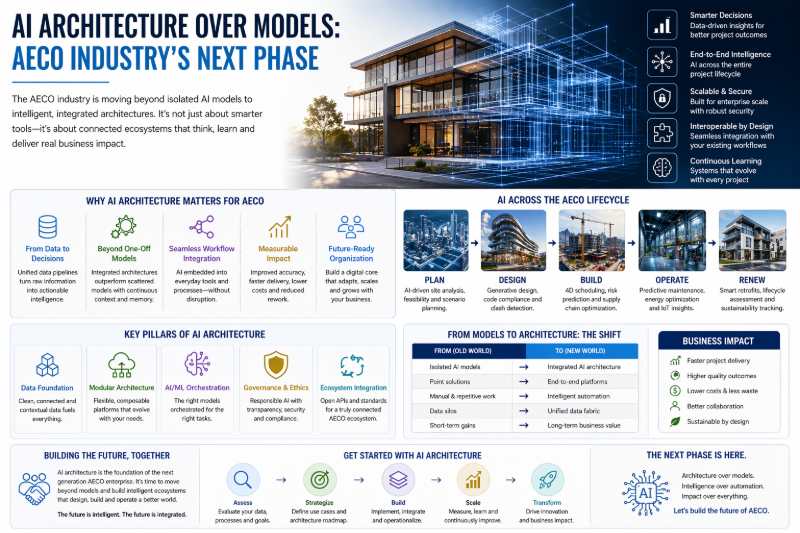
For the past three years, the conversation around AI has centered on models: GPT, Claude, Gemini, and countless others. Organizations rushed to implement these models, expecting immediate transformation. However, the reality has proven more complex. A model is merely a component—the engine, if you will. What determines success is the architecture that surrounds it: how data flows, where decisions are made, how systems communicate, and how human expertise integrates with machine intelligence.
In the Indian AECO industry, this distinction is particularly important. Consider a construction firm in Bangalore managing a ₹500 crore infrastructure project. The project involves hundreds of contractors, thousands of material suppliers, complex regulatory compliance requirements, and real-time site monitoring. Deploying a single AI model to "optimize" this won't work. What's needed is a comprehensive AI architecture that connects project management systems, supply chain networks, safety protocols, and financial tracking—with AI intelligently embedded throughout.
This is where platforms like AECORD become crucial. AECORD's marketplace infrastructure is itself built on architectural principles that enable AI integration at every layer: from connecting professionals and suppliers to facilitating real-time project collaboration and risk assessment.

Build cost · Bengaluru, May 2026
Why Architectural Thinking Matters for AECO Professionals
Moving Beyond Point Solutions
Many organizations in India's AECO sector have implemented AI in isolated pockets: a BIM visualization tool here, an automated invoice processing system there, a predictive maintenance algorithm elsewhere. While each provides value individually, they don't compound. An architectural approach asks: How do these systems talk to each other? How does the output from one system inform decisions in another?
For instance, AI-powered site safety monitoring can detect potential hazards and trigger alerts. But if that system isn't architecturally connected to the project scheduling system, the compliance team, and the insurance documentation system, the value remains limited. A proper architecture ensures that safety insights automatically update risk assessments, which inform insurance premiums, which flow into project cost tracking.
Data as the Foundation
Every AI architecture begins with data infrastructure. Indian AECO firms often struggle with data fragmentation: project data in one system, financial data in another, personnel records in a third, supplier information scattered across emails and spreadsheets. This fragmentation makes sophisticated AI implementation nearly impossible.
Building a proper architecture means first addressing data governance. This includes:
Data standardization: Ensuring that terms like "project cost," "timeline," and "resource allocation" mean the same thing across all systems
Data integration: Creating pipelines that consolidate information from various sources into a unified data lake
Data quality: Implementing validation rules to ensure the information feeding AI systems is accurate and complete
Data security: Protecting sensitive project information, proprietary designs, and client data according to Indian regulations
Companies like those connecting through AECORD benefit from a marketplace that inherently standardizes data formats and integration points, reducing the friction of architectural implementation.
Frequently asked
The Three Layers of AI Architecture
Layer 1: The Data Foundation
This layer encompasses data collection, storage, and preparation. In AECO contexts, this means:
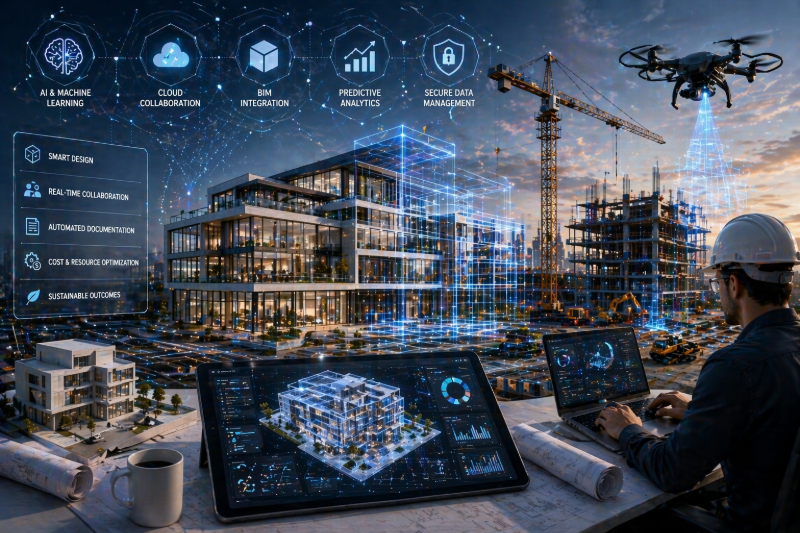
IoT sensors on construction sites capturing real-time conditions (temperature, humidity, equipment status)
BIM models storing structured information about building components and specifications
Project management systems recording timelines, resource allocation, and progress metrics
Financial systems tracking costs, invoices, and payment flows
In Mumbai or Delhi, a mid-sized construction firm might have sensors across 15 active sites, generating terabytes of data monthly. Without proper architectural planning, this data becomes noise rather than insight. A well-designed data layer transforms it into actionable intelligence.
Layer 2: The Intelligence Layer
This is where AI models and algorithms operate, but not in isolation. The intelligence layer includes:
Predictive models: Forecasting project delays, cost overruns, or safety incidents
Optimization algorithms: Finding the most efficient resource allocation, scheduling, or supply chain routing
Classification systems: Automatically categorizing documents, flagging compliance issues, or identifying defects in quality checks
Recommendation engines: Suggesting optimal contractor selections, material suppliers, or design alternatives
The key architectural principle here is modularity. Each AI component should be independently deployable and updatable without disrupting the entire system. This is especially important in India's diverse AECO sector, where regulations vary by state and project types range from residential to industrial to infrastructure.
Layer 3: The Decision and Action Layer
This is where AI connects to human decision-makers and automated systems. Architecture here determines:
How AI recommendations are presented to project managers, engineers, and decision-makers
Which decisions are automated (e.g., routine purchase orders) versus which require human approval
How feedback loops work—when a recommendation proves wrong, how does the system learn?
What audit trails and explainability mechanisms exist for regulatory compliance
In a construction project in Hyderabad, an AI system might predict that a particular supplier's delivery is at risk. The architecture determines: Is this flagged in the project manager's dashboard? Does it trigger automatic sourcing of alternatives? Who gets notified? What documentation is created for compliance records?
Architectural Patterns for Indian AECO Organizations
The Hub-and-Spoke Model
Many large AECO firms operate multiple projects simultaneously across different cities and regions. A hub-and-spoke AI architecture establishes a central intelligence hub (often cloud-based) that connects to multiple project-level systems. This allows:
Centralized model management and updates
Cross-project learning and pattern recognition
Consistent compliance and governance across all projects
Economies of scale in AI infrastructure investment
A ₹1000 crore construction conglomerate with projects in Bangalore, Chennai, Pune, and Jaipur can benefit significantly from this model, leveraging insights from one project to improve outcomes in others.
The Federated Learning Model
Given data sensitivity and regulatory concerns in India's construction sector, federated learning offers an alternative. AI models are trained across distributed data sources without centralizing sensitive information. This is particularly valuable for:
Proprietary project information that companies don't want to share
Compliance with data localization requirements
Protecting intellectual property in design and engineering
Through platforms like AECORD, multiple independent contractors and suppliers can collectively benefit from AI insights without exposing their individual project data.
The Microservices Architecture
Rather than monolithic AI systems, microservices architecture breaks AI capabilities into small, focused services: one for safety prediction, one for cost estimation, one for schedule optimization, and so on. Benefits include:
Flexibility to update or replace individual services without system-wide disruption
Easier integration with existing legacy systems common in Indian firms
Ability to scale specific services based on demand
Reduced complexity and faster development cycles
Real-World Implementation Considerations for India
Regulatory Compliance
India's construction sector operates under multiple regulatory frameworks: Building codes vary by state, labor laws have specific requirements, environmental compliance differs between regions, and tax regulations affect financial systems. An AI architecture must accommodate this complexity. This means:
Modular compliance engines that can be configured for different jurisdictions
Audit trails that satisfy GST, income tax, and project compliance requirements
Automated flagging of potential compliance violations based on project location and type
Infrastructure and Connectivity
Not all of India has robust, consistent internet connectivity. An effective AI architecture must account for this reality by:
Supporting edge computing—running AI models on-site when cloud connectivity is unreliable
Implementing intelligent caching and synchronization for intermittent connectivity
Designing systems that gracefully degrade when bandwidth is limited
A construction site in a remote area of Maharashtra shouldn't be disadvantaged by poor connectivity. The architecture should enable local AI processing with periodic synchronization to central systems.
Cost Considerations
Indian AECO firms operate with tighter margins than their global counterparts. An AI architecture must deliver clear ROI within 12-18 months. This requires:
Starting with high-impact use cases: cost overrun prediction, safety incident prevention, schedule optimization
Phased implementation rather than big-bang deployments
Leveraging cloud services with pay-as-you-go models rather than capital-intensive infrastructure investments
Building on existing systems rather than replacing them wholesale
A firm might invest ₹50-100 lakhs in initial AI architecture setup but recoup that through 2-3% cost savings on a ₹100 crore project within the first year.
The Role of Platforms and Marketplaces
Individual firms shouldn't need to build AI architectures from scratch. This is where marketplace platforms become essential. AECORD, as a B2B2C marketplace for AECO professionals, provides architectural advantages:
Standardized data formats: All participants use consistent data structures, enabling AI systems to work across the network
Network effects: More data from more participants improves AI models for everyone
Integrated services: Rather than building separate systems, firms access pre-built AI capabilities through the platform
Reduced implementation complexity: Instead of designing architecture from scratch, firms configure existing architectural patterns
A contractor using AECORD can instantly access AI-powered supplier recommendations, cost estimation tools, and risk assessment systems without building these capabilities independently.
The Path Forward
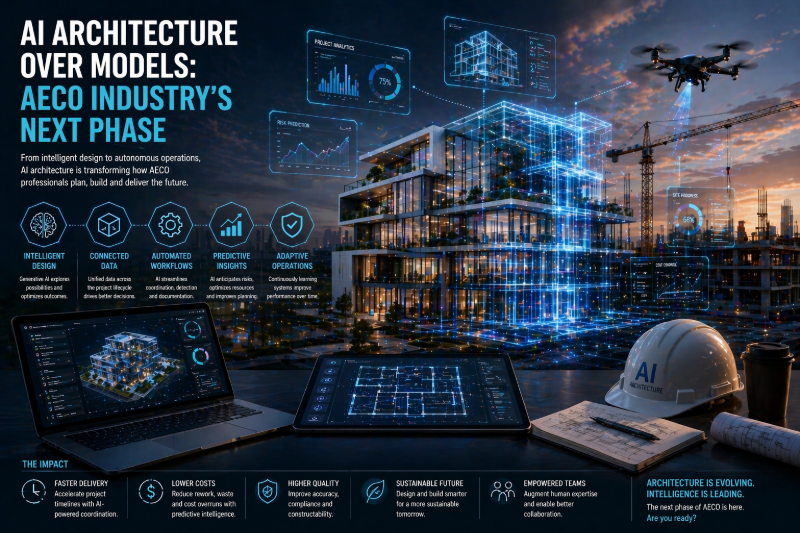
The next phase of AI isn't about more powerful models or flashier capabilities. It's about sustainable, integrated, architecturally sound systems that deliver consistent value. For India's AECO sector, this means:
Shifting investment from point solutions to integrated architectures
Prioritizing data infrastructure as the foundation for AI
Building flexibility and modularity into systems from the start
Leveraging platforms and marketplaces to reduce implementation burden
Designing for India's unique constraints and opportunities
Organizations that master architectural thinking will gain sustainable competitive advantages. Those that chase the latest model will find themselves perpetually playing catch-up.
Getting Started with AI Architecture
If you're an AECO professional in India considering AI implementation, begin with these steps:
Audit your current systems: Map out existing tools, data sources, and decision-making processes
Identify high-impact opportunities: Where would AI deliver the greatest value with the least implementation complexity?
Design incrementally: Don't try to architect everything at once; build modular components that can evolve
Leverage existing platforms: Explore how marketplaces like AECORD can provide architectural shortcuts
Invest in data quality: Before implementing AI, ensure your foundational data layer is solid
The professionals and firms that understand this architectural shift will lead India's AECO sector into its next phase of transformation. Rather than viewing AI as a technology to implement, view it as infrastructure to architect—and the results will follow.
Ready to explore how AI architecture can benefit your AECO operations? Connect with experienced architects, engineers, and AI specialists on AECORD who understand how to design and implement intelligent systems specifically for India's construction and operations landscape. Find the right partner to help you build your AI architecture today.
Frequently Asked Questions
What is the difference between AI models and AI architecture in construction?
An AI model is just the engine—a single component like GPT or Claude. AI architecture is the comprehensive system that surrounds it, including how data flows, where decisions are made, how systems communicate, and how human expertise integrates with machine intelligence. Success in AECO depends on the architecture, not just the model.
Why do isolated AI tools fail in construction projects?
Point solutions like individual BIM tools or invoice automation systems don't compound their value when disconnected. An architectural approach ensures these systems communicate with each other—for example, safety alerts automatically updating risk assessments and insurance documentation—creating exponential benefits.
What is data fragmentation and why does it prevent AI implementation?
Data fragmentation occurs when project information is scattered across multiple systems and spreadsheets with inconsistent definitions. This makes sophisticated AI implementation nearly impossible because AI systems need unified, standardized data to function effectively across an organization.
What are the key components of data infrastructure for AECO firms?
Proper data infrastructure requires data standardization (consistent definitions across systems), data integration (consolidated pipelines into a unified data lake), data quality (validation rules for accuracy), and data security (protection of sensitive project information).
How does AI architecture transform construction project management?
AI architecture connects project management, supply chain, safety protocols, and financial tracking into one integrated system. This allows AI to intelligently embed throughout operations, so insights from one area automatically inform decisions in others, creating comprehensive project optimization.