

Understanding 8mm Bison Cement Bonded Particle Board: A Comprehensive Guide for Indian Construction Professionals
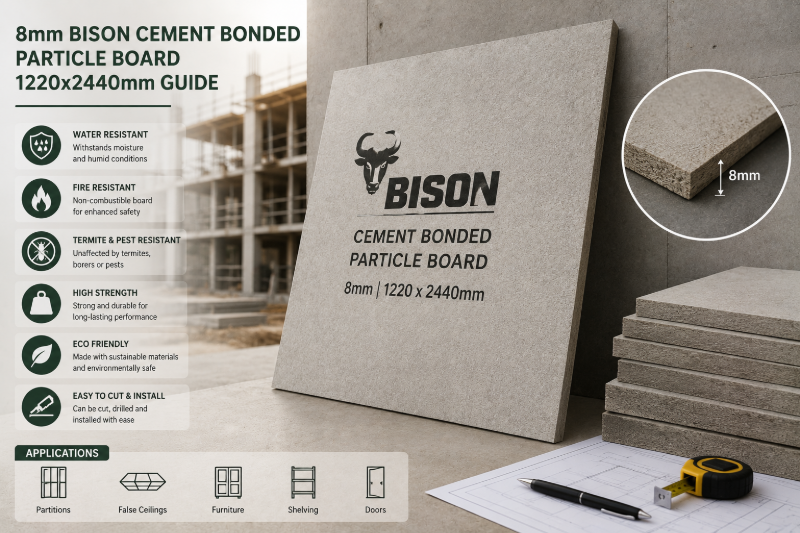
Cement bonded particle board (CBPB) has become an increasingly popular choice in the Indian construction industry, particularly for applications requiring durability, moisture resistance, and cost-effectiveness. The 8mm thickness variant in the standard 1220mm x 2440mm size has emerged as a versatile solution for architects, engineers, and construction professionals across residential, commercial, and industrial projects.
Whether you're specifying materials for a new build, renovation project, or industrial application, understanding the properties, applications, and advantages of 8mm Bison cement bonded particle board is essential for making informed decisions. This guide explores everything you need to know about this material, particularly in the Indian construction context.
Build cost · Bengaluru, May 2026
What is Cement Bonded Particle Board?
Material Composition and Manufacturing Process
Cement bonded particle board is an engineered composite material manufactured by combining wood particles with Portland cement and water. Unlike traditional plywood or MDF, CBPB uses cement as the primary binder rather than synthetic adhesives, making it inherently more moisture-resistant and durable in humid environments.
The manufacturing process involves:
Mixing wood particles with Portland cement, silica fume, and additives
Pressing the mixture under high pressure to form uniform panels
Curing the panels to achieve optimal strength and stability
Quality testing to ensure compliance with international standards
Bison, a leading manufacturer in this space, produces cement bonded particle board that meets stringent quality standards, making it suitable for demanding Indian construction applications where moisture, temperature fluctuations, and durability are critical concerns.
The 8mm Thickness Specification
The 8mm thickness represents an optimal balance between strength, weight, and cost-effectiveness. This thickness is particularly suitable for:
Wall cladding and external finishes
Flooring underlayment in moisture-prone areas
Interior partition backing
Ceiling applications in commercial spaces
Acoustic panel backing
The standard 1220mm x 2440mm sheet size aligns with international specifications, making it easy to plan layouts and minimize wastage during installation.
Frequently asked
Key Properties and Advantages
Moisture and Water Resistance
One of the most significant advantages of cement bonded particle board is its exceptional moisture resistance. Unlike plywood or particle board that can swell and deteriorate when exposed to moisture, CBPB maintains its dimensional stability even in high-humidity environments.
This makes it ideal for Indian climates, particularly in coastal regions like Mumbai, Chennai, and Kolkata where humidity levels can exceed 80%. The cement matrix prevents water absorption, protecting the wood particles within and ensuring long-term structural integrity.
Testing shows that properly installed 8mm Bison CBPB can withstand prolonged exposure to moisture without significant dimensional change—a critical advantage over conventional materials in India's monsoon-prone regions.
Durability and Longevity
Cement bonded particle board exhibits superior durability compared to conventional particle boards. The cement binding matrix provides natural resistance to:
Fungal and microbial growth
Termite and insect attacks
Weather-related degradation
Chemical exposure in industrial environments
In the Indian context, where termite infestation and fungal growth are common challenges, particularly in tropical and subtropical regions, CBPB offers a reliable solution that doesn't require additional chemical treatments.
Fire Resistance
The cement composition provides inherent fire-resistant properties. While not classified as non-combustible, Bison cement bonded particle board demonstrates superior fire performance compared to conventional wood-based boards, making it suitable for applications where fire safety is a concern.
This property is particularly valuable for commercial buildings, industrial facilities, and public structures in India where fire codes are becoming increasingly stringent.
Acoustic Properties
The dense structure of 8mm CBPB provides moderate sound absorption and noise reduction characteristics. When used as backing for acoustic panels or in layered systems, it contributes to improved sound insulation—beneficial for office spaces, educational institutions, and residential buildings in urban Indian environments.
Applications in Indian Construction
Residential Construction
In residential projects across India, 8mm Bison cement bonded particle board finds applications in:
Kitchen and bathroom areas: As backing for tiles or wall finishes, where moisture resistance is critical
Flooring underlayment: Particularly in kitchens, bathrooms, and balconies where water exposure is likely
Partition walls: In multi-story residential complexes where durability and fire safety matter
Balcony cladding: Protecting structural elements from weather exposure
For residential projects in cities like Bangalore, Hyderabad, and Pune where construction standards are evolving, CBPB offers a premium alternative to traditional materials at competitive cost points.
Commercial and Office Spaces
Commercial applications benefit significantly from CBPB's durability and low maintenance requirements:
Suspended ceiling systems and acoustic panel backing
Interior wall cladding in high-traffic areas
Flooring underlayment in commercial kitchens and food courts
Partition systems in open office layouts
The material's ability to maintain structural integrity over decades reduces maintenance costs—an important consideration for property managers and facility operators across Indian metros.
Industrial Applications
Industrial facilities in India increasingly specify cement bonded particle board for:
Wall cladding in manufacturing plants where moisture and chemical exposure are concerns
Flooring systems in food processing and dairy facilities
Backing for insulation systems in cold storage facilities
Temporary partitioning in industrial warehouses
The material's resistance to moisture, chemicals, and biological growth makes it particularly valuable in food processing and agricultural facilities across India.
Installation and Handling Considerations
Site Preparation and Storage
While CBPB is moisture-resistant, proper site management during installation is essential:
Store sheets in a dry, well-ventilated area, preferably indoors
Protect from direct water spray and flooding
Allow adequate air circulation to prevent condensation
Stack sheets horizontally on level, clean surfaces
Use spacers between sheets to ensure air flow
In Indian construction sites where monsoon rains and humid conditions are common, proper material management is crucial for maintaining product quality.
Cutting and Fabrication
The 8mm thickness is easily workable with standard tools:
Use fine-toothed circular saws or table saws for straight cuts
Wear dust masks during cutting, as cement dust inhalation should be avoided
Pre-drill holes for fasteners to prevent splitting
Allow freshly cut edges to dry before exposure to moisture
The material machines cleanly and doesn't produce the tear-out common with conventional particle boards, making it easier for carpenters and fabricators to work with.
Fastening and Attachment
Proper fastening ensures long-term performance:
Use corrosion-resistant screws or fasteners (stainless steel or galvanized)
Space fasteners 150-200mm apart for optimal holding power
Avoid over-tightening, which can damage the material
Use appropriate adhesives (cement-based or polyurethane) for bonding
Cost Considerations in the Indian Market
Pricing and Value Proposition
The cost of 8mm Bison cement bonded particle board in India typically ranges from ₹1,200 to ₹1,800 per sheet (1220mm x 2440mm), depending on:
Current cement and raw material prices
Regional availability and transportation costs
Order volume and distributor margins
Market conditions and seasonal variations
While this represents a premium over standard particle board (₹400-600 per sheet), the superior durability, reduced maintenance, and longer lifespan provide excellent long-term value, particularly for moisture-prone applications.
Life Cycle Cost Analysis
When evaluating CBPB for projects, consider the complete life cycle cost:
Initial material cost: Higher than conventional boards but competitive with premium plywood
Installation labor: Similar to plywood, no special expertise required
Maintenance costs: Significantly lower due to durability and moisture resistance
Replacement cycles: Longer service life reduces replacement frequency
Warranty and guarantees: Reputable manufacturers like Bison typically offer extended warranties
For applications in moisture-prone areas, the total cost of ownership often favors CBPB over cheaper alternatives that require frequent replacement or maintenance.
Comparison with Alternative Materials
CBPB vs. Plywood
While plywood is widely used in Indian construction, 8mm CBPB offers distinct advantages:
Superior moisture resistance without lamination
No delamination issues in humid environments
Better fire performance
Lower maintenance requirements
Plywood remains cost-competitive for dry applications, but CBPB excels in moisture-critical areas.
CBPB vs. Conventional Particle Board
Standard particle board is cheaper but significantly inferior for demanding applications:
Absorbs moisture, leading to swelling and warping
Susceptible to termite and fungal attack
Shorter lifespan, particularly in Indian climates
Poor fire performance
In moisture-prone applications, the durability advantage of CBPB typically justifies the additional investment.
CBPB vs. Cement Board
While both are cement-based, CBPB offers advantages for certain applications:
Lighter weight, easier to handle and install
Better workability and machinability
Lower cost per sheet
Suitable for non-load-bearing applications
Cement board remains preferred for wet areas like shower enclosures, while CBPB excels for general wall and floor backing.
Specifications and Standards Compliance
Indian and International Standards
Bison cement bonded particle board typically complies with:
IS 12823:2018 - Indian Standard for cement-bonded particle boards
EN 634 - European Standard for cement-bonded particle boards
ASTM D1037 - American Standard test methods for evaluating properties
Compliance with these standards ensures consistent quality, dimensional accuracy, and performance characteristics across batches and suppliers.
Key Performance Specifications for 8mm Thickness
Density: 1,100-1,300 kg/m³
Modulus of Rupture: Minimum 8-10 MPa
Modulus of Elasticity: Minimum 3,000-4,000 MPa
Water Absorption (24 hours): Maximum 15-20%
Thickness Swelling: Maximum 1-2% after 24-hour water immersion
Fire Rating: Generally Euroclass D or better
These specifications ensure that the material performs reliably in demanding Indian construction environments.
Finding Quality Suppliers and Professionals on AECORD
When specifying 8mm Bison cement bonded particle board for your Indian construction project, working with qualified professionals ensures proper selection, installation, and performance. AECORD, India's leading B2B2C marketplace for AECO professionals, connects architects, engineers, and contractors with vetted suppliers, installers, and specialists experienced in cement bonded particle board applications.
Whether you're sourcing materials, seeking installation expertise, or requiring technical consultation for moisture-critical applications, AECORD provides access to a network of professionals who understand the nuances of cement bonded particle board in Indian climates and construction practices.
Best Practices for Project Success
Design Considerations
Specify CBPB for moisture-prone areas (kitchens, bathrooms, balconies)
Plan for proper ventilation behind cladding systems
Consider edge finishing and protection in high-traffic areas
Coordinate with other materials to ensure compatibility
Installation Best Practices
Ensure substrate is clean, dry, and level before installation
Maintain proper spacing and fastener schedules
Use appropriate sealants and finishing materials
Allow adequate curing time before exposure to moisture
Follow manufacturer's installation guidelines
Quality Control
Verify material certifications and batch documentation
Inspect sheets for damage before installation
Conduct dimensional verification on critical applications
Document installation photos for warranty purposes
Conclusion
The 8mm thickness Bison cement bonded particle board in 1220mm x 2440mm format represents a sophisticated solution for Indian construction professionals seeking durable, moisture-resistant, and cost-effective materials. Its superior performance in humid environments, resistance to biological degradation, and long service life make it particularly valuable for residential, commercial, and industrial applications across India's diverse climates.
By understanding the material's properties, applications, and installation requirements, architects, engineers, and contractors can make informed decisions that enhance project durability and reduce long-term maintenance costs. Whether you're designing a residential kitchen in Mumbai, specifying materials for a commercial office in Bangalore, or planning an industrial facility in Gujarat, cement bonded particle board offers reliable performance backed by established standards and proven track records.
To connect with experienced professionals, verified suppliers, and installation specialists for your cement bonded particle board projects, explore AECORD's comprehensive network of AECO professionals. Whether you need technical consultation, material sourcing, or installation services, AECORD makes it easy to find qualified partners who understand the specific requirements of Indian construction projects and can help ensure your project's success.
Frequently Asked Questions
What is 8mm Bison cement bonded particle board used for in construction?
8mm Bison cement bonded particle board is used for wall cladding, flooring underlayment, interior partitions, ceiling applications, and acoustic panel backing. Its 8mm thickness provides an optimal balance between strength and cost-effectiveness for these applications.
Why is cement bonded particle board better than plywood in humid climates?
Cement bonded particle board uses Portland cement as its primary binder instead of synthetic adhesives, making it inherently moisture-resistant and dimensionally stable in high-humidity environments. It maintains structural integrity even in coastal regions with humidity levels exceeding 80%, unlike plywood which can swell and deteriorate.
Is cement bonded particle board resistant to termites and fungal growth?
Yes, the cement binding matrix in CBPB provides natural resistance to fungal growth, microbial attacks, and termite infestation. This makes it particularly valuable in India's tropical and subtropical regions where these issues are common challenges.
What are the standard dimensions of Bison cement bonded particle board sheets?
The standard size is 1220mm x 2440mm, which aligns with international specifications and helps minimize wastage during installation while making layout planning easier for construction professionals.
How is cement bonded particle board manufactured?
CBPB is manufactured by mixing wood particles with Portland cement, silica fume, and additives, then pressing the mixture under high pressure and curing the panels to achieve optimal strength. The process includes quality testing to ensure compliance with international standards.