

Brick vs AAC Block: Comprehensive Guide for Indian Construction Professionals
When it comes to selecting building materials for construction projects in India, the choice between traditional bricks and Autoclaved Aerated Concrete (AAC) blocks is one of the most critical decisions builders, architects, and engineers face. Both materials have been widely used across Indian construction sites, from residential complexes in Mumbai and Bangalore to commercial projects in Delhi and Hyderabad. Understanding the differences between these two options can significantly impact your project's cost, timeline, durability, and overall quality.
This comprehensive guide explores the key differences between bricks and AAC blocks, helping you make an informed decision for your next construction project.
Build cost · Bengaluru, May 2026
Understanding the Basics: What Are Bricks and AAC Blocks?
Traditional Bricks
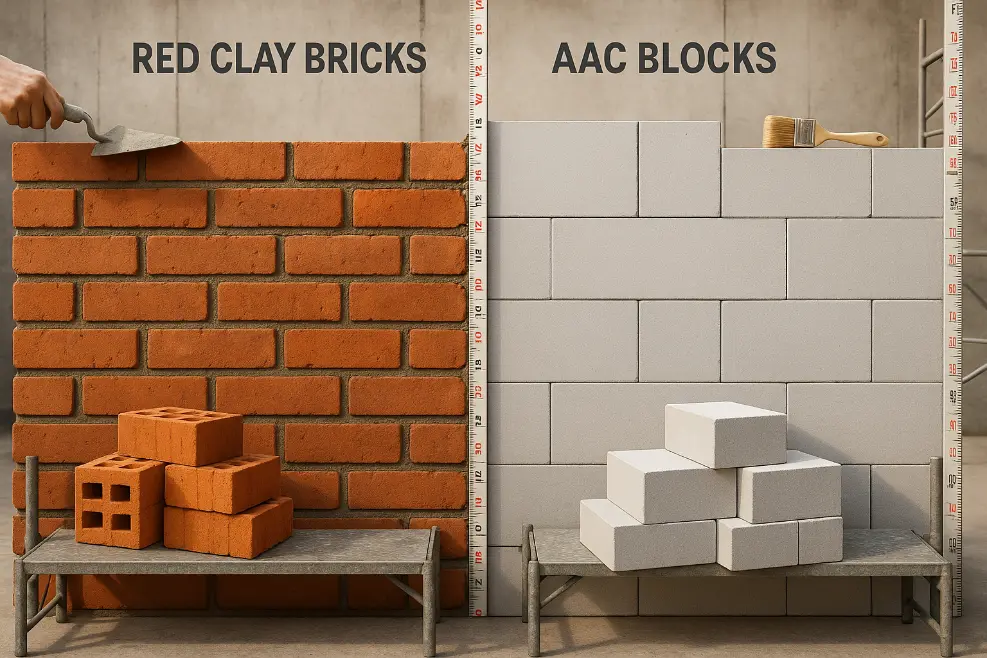
Traditional bricks have been used in Indian construction for centuries. They are made from clay that is molded, dried, and then fired in kilns at extremely high temperatures (around 1000-1200°C). This process creates a durable, solid building material that has proven its longevity across countless structures across India.
Standard Indian bricks typically measure 190mm × 90mm × 90mm and are classified into different grades based on their crushing strength, including First Class, Second Class, and Third Class bricks.
AAC Blocks
AAC (Autoclaved Aerated Concrete) blocks are a relatively newer building material in India, gaining significant popularity over the last two decades. These blocks are manufactured using a combination of cement, lime, silica sand, and aluminum powder. The aluminum powder creates gas bubbles within the material, resulting in a lightweight, porous block. The "autoclaved" process involves curing these blocks under high pressure and temperature in an autoclave, which gives them their strength and durability.
AAC blocks are available in various sizes, with common dimensions being 600mm × 200mm × 100mm, 600mm × 200mm × 150mm, and 600mm × 200mm × 200mm.
Frequently asked
Cost Comparison: Brick vs AAC Block
Initial Material Cost
As of 2024, the cost dynamics between bricks and AAC blocks in India vary by region and market conditions:
Traditional Bricks: Approximately ₹4,000 to ₹8,000 per thousand bricks, depending on quality and location. In major metros like Mumbai and Delhi, prices tend toward the higher end.
AAC Blocks: Typically cost ₹6,500 to ₹12,000 per cubic meter, which translates to roughly ₹3,500 to ₹7,000 per thousand block units.
While the per-unit cost may seem comparable, the total project cost differs significantly due to the volume required and labor costs associated with each material.
Hidden Costs and Total Cost of Ownership
When calculating true project costs, consider these factors:
Mortar Requirements: AAC blocks require less mortar (thin-joint mortar of 3-5mm) compared to traditional bricks (10-12mm joints), reducing material waste and overall mortar consumption by 40-50%.
Labor Costs: AAC blocks are larger and lighter, allowing faster construction. A mason can lay approximately 400-500 AAC blocks per day compared to 300-400 bricks. This translates to significant labor savings on projects in Bangalore, Pune, and other growing metros.
Plastering and Finishing: AAC blocks require less plaster due to better dimensional accuracy, saving approximately 15-20% on finishing costs.
Transportation: Bricks are heavier, resulting in higher transportation costs, especially for projects located in tier-2 and tier-3 cities far from brick manufacturing units.
For a typical 1,000 sq. ft. residential construction in India, AAC blocks can reduce total wall construction costs by 10-15% compared to traditional bricks when accounting for all associated expenses.
Structural Performance and Strength
Compressive Strength
Traditional bricks typically offer compressive strength ranging from 3.5 MPa to 10 MPa, depending on their grade. First-class bricks provide the highest strength.
AAC blocks generally provide compressive strength between 3.5 to 5.0 MPa, which is adequate for most low-to-mid-rise residential and commercial buildings. For high-rise structures or projects requiring exceptional strength, traditional bricks may be preferable, though reinforced concrete columns are typically used regardless of infill material.
Load-Bearing Capacity
Both materials are suitable for load-bearing walls in buildings up to 4-5 stories. For taller structures, reinforced concrete frames with either material as infill are standard practice across Indian construction sites. The choice between materials in such cases becomes more about other factors like thermal performance and cost efficiency.
Thermal and Moisture Properties
Thermal Insulation
This is where AAC blocks excel significantly. The air pockets within AAC blocks provide natural insulation, offering thermal conductivity of approximately 0.14-0.18 W/mK compared to bricks at 0.6-1.0 W/mK. This means AAC blocks are 3-5 times more insulating than traditional bricks.
For projects in hot climates like Hyderabad, Chennai, and Delhi, this superior thermal performance translates to:
Reduced air conditioning costs by 20-30%
Better indoor comfort during extreme weather
Lower overall energy consumption
Compliance with green building standards like LEED and IGBC
Moisture Resistance and Durability
Traditional bricks have been proven to last 100+ years with minimal maintenance, making them extremely durable. They naturally resist moisture and weathering.
AAC blocks, when properly manufactured and installed, also offer excellent durability. However, they are more porous and can absorb moisture if not adequately protected with waterproofing measures. In high-moisture environments (coastal areas like Mumbai, Goa, or regions with heavy rainfall), proper waterproofing becomes critical for AAC structures.
Both materials require appropriate waterproofing treatments on external surfaces, particularly in the Indian climate with its monsoons and temperature variations.
Construction Speed and Labor Efficiency
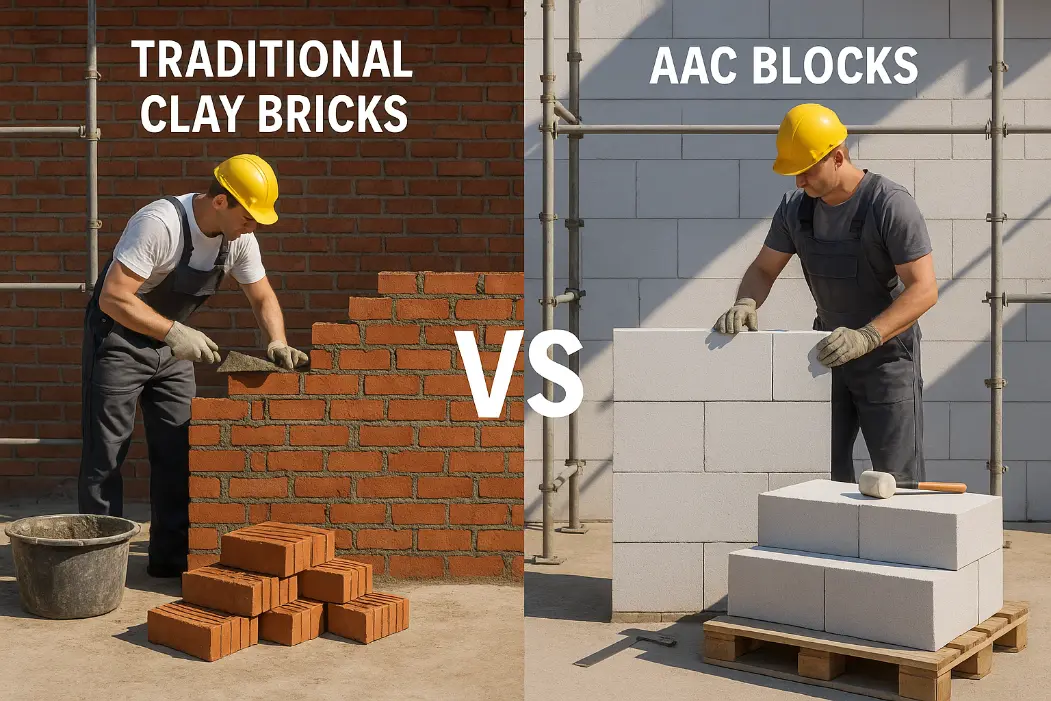
One of AAC blocks' most significant advantages is construction speed. The larger size of AAC blocks (600mm length) compared to bricks (190mm length) means:
Fewer Units Required: A wall requires approximately 40% fewer AAC blocks than bricks, reducing the number of joints and installation points.
Faster Installation: Experienced masons working on projects across Indian cities report 30-40% faster wall construction with AAC blocks.
Reduced Project Timeline: For large-scale projects, this can mean completing structural work weeks earlier, reducing financing costs and accelerating project handover.
Better Precision: AAC blocks have tighter dimensional tolerances, resulting in straighter walls and more accurate construction.
This efficiency is particularly valuable in competitive markets like Bangalore and Pune, where faster project completion can provide significant competitive advantages.
Environmental and Sustainability Considerations
Brick Manufacturing Impact
Traditional brick production involves firing clay in kilns, which is energy-intensive and contributes to carbon emissions. The brick industry in India faces scrutiny for:
High energy consumption
Air pollution from kiln emissions
Land degradation from clay extraction
AAC Block Manufacturing Impact
While AAC block manufacturing also requires energy, it generally has a lower carbon footprint than brick production. AAC blocks contain recycled materials in some cases and produce less waste during manufacturing. However, the autoclaving process is energy-intensive.
For environmentally conscious projects aiming for green building certifications in India, AAC blocks often score better on environmental impact assessments. Many LEED-certified and IGBC Green Building projects across Indian metros prefer AAC blocks for their sustainability profile.
Acoustic Properties
The porous nature of AAC blocks provides better sound insulation compared to solid bricks. For projects in urban areas with high noise levels—such as properties near highways in Delhi, Mumbai, or Bangalore—AAC blocks can reduce external noise by 40-50 decibels, compared to 35-45 decibels for brick walls of similar thickness.
This advantage makes AAC blocks particularly suitable for residential projects in busy commercial areas and near transportation corridors.
Workability and Finishing
Cutting and Modification
AAC blocks are significantly easier to cut, drill, and modify compared to bricks. This is advantageous when:
Accommodating electrical conduits and plumbing pipes
Creating custom wall configurations
Making post-construction modifications
Bricks require more skilled labor for cutting and are more prone to breakage during modification, increasing waste and labor costs.
Surface Finish Quality
AAC blocks provide better dimensional accuracy, resulting in more uniform wall surfaces. This reduces the thickness of plaster required and improves the final aesthetic quality, which is particularly important for premium residential and commercial projects across Indian metros.
Regional Considerations in India
Coastal Regions (Mumbai, Goa, Chennai)
In coastal areas with high humidity and salt spray, traditional bricks may perform better without extensive waterproofing. However, properly treated AAC blocks with quality external coatings also perform well.
High-Rainfall Regions (Kerala, Northeast India)
Regions with heavy monsoons require robust waterproofing regardless of material choice. AAC blocks may require more aggressive waterproofing measures.
Hot-Dry Regions (Rajasthan, Delhi, Hyderabad)
In these areas, AAC blocks' superior thermal insulation provides significant advantages, making them increasingly popular for both residential and commercial projects.
Tier-2 and Tier-3 Cities
Availability and local expertise vary significantly. In some regions, traditional bricks remain the default choice due to established supply chains and mason familiarity.
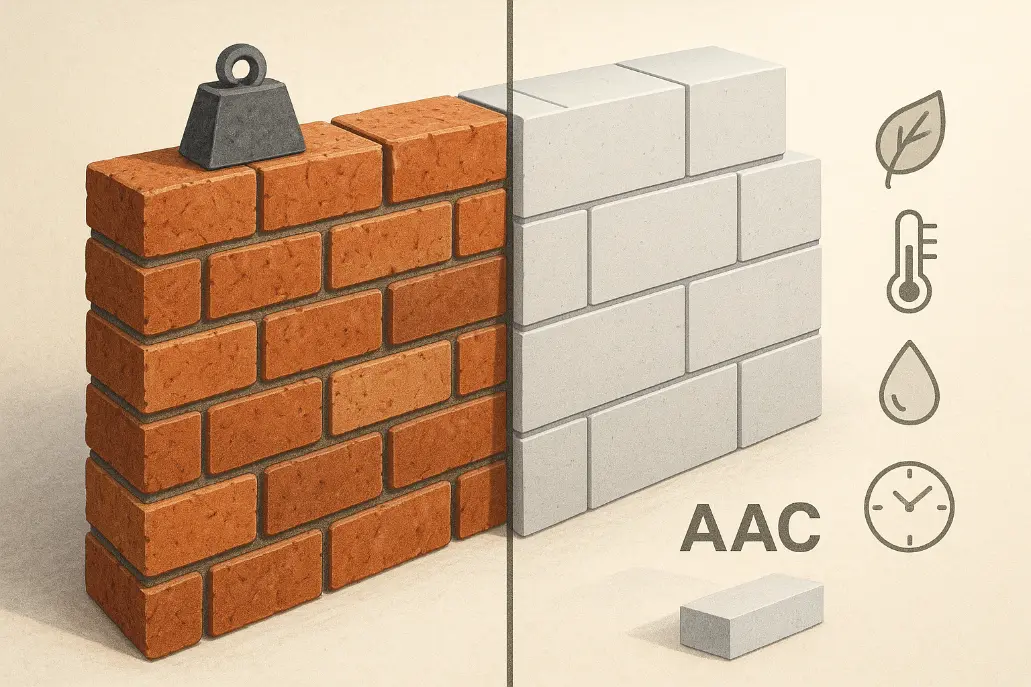
Making Your Decision: A Practical Framework
Choose traditional bricks if you:
Are constructing in coastal regions without proper waterproofing infrastructure
Need maximum durability for heritage or long-term projects
Have readily available local brick sources
Are working with masons highly experienced in brick construction
Require the lowest initial material cost
Choose AAC blocks if you:
Want to minimize overall project costs including labor and finishing
Prioritize construction speed and project timeline
Require superior thermal performance for energy efficiency
Need better acoustic properties
Are targeting green building certifications
Require flexibility for modifications and installations
Are building in hot-dry climates
Finding the Right Professionals for Your Project
Whether you choose bricks or AAC blocks, selecting experienced professionals is crucial for project success. AECORD connects you with qualified architects, structural engineers, contractors, and masons across India who specialize in both traditional and modern construction materials. On AECORD, you can find professionals with proven expertise in your specific region and material preference.
When evaluating contractors and masons on AECORD, ensure they have specific experience with your chosen material and can provide references from similar projects in your region.
Conclusion
The brick vs. AAC block decision is not about one material being universally superior—it's about selecting the right material for your specific project requirements, location, budget, and timeline. Traditional bricks offer proven durability and reliability, while AAC blocks provide modern advantages in cost efficiency, speed, and thermal performance.
For most contemporary construction projects in Indian metros and growing cities, AAC blocks increasingly represent the practical choice due to their overall cost-effectiveness and performance advantages. However, regional factors, local expertise, and specific project requirements should always guide your final decision.
Ready to discuss your material choice with experienced professionals? Visit AECORD today to connect with architects, engineers, and contractors who can provide expert guidance tailored to your project's unique needs and location.