


Artificial Reef Systems and 3D Printed Seawalls: India’s Future of Living Coastal Infrastructure
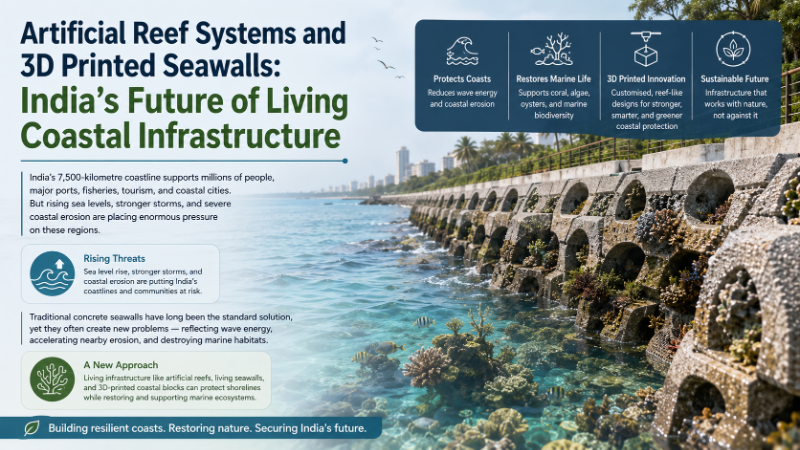
India’s 7,500-kilometre coastline supports millions of people, major ports, fisheries, tourism, and coastal cities. But rising sea levels, stronger storms, and severe coastal erosion are placing enormous pressure on these regions. Traditional concrete seawalls have long been the standard solution, yet they often create new problems — reflecting wave energy, accelerating nearby erosion, and destroying marine habitats.
Today, a new generation of “living infrastructure” is changing how the world thinks about coastal protection. Technologies such as artificial reef systems, living seawalls, and 3D-printed coastal blocks are proving that infrastructure can protect shorelines while also supporting marine ecosystems.
Build cost · Bengaluru, May 2026
What Are Artificial Reef Systems?
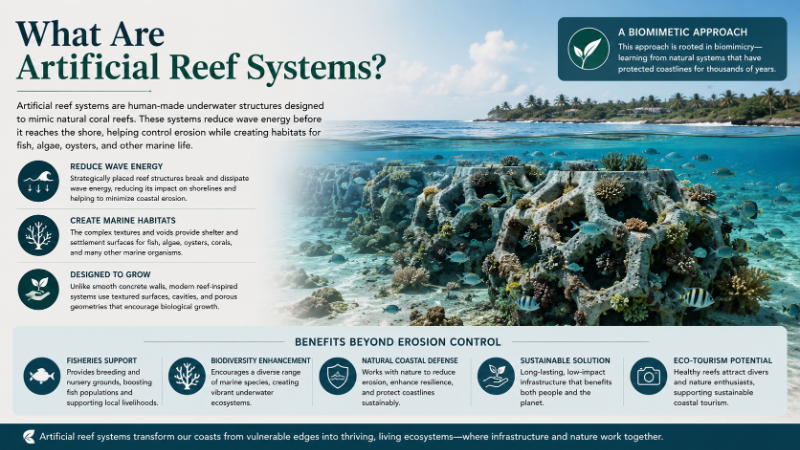
Artificial reef systems are human-made underwater structures designed to mimic natural coral reefs. These systems reduce wave energy before it reaches the shore, helping control erosion while creating habitats for fish, algae, oysters, and other marine life.
Unlike smooth concrete walls, modern reef-inspired systems use textured surfaces, cavities, and porous geometries that encourage biological growth. Over time, these structures evolve into living ecosystems rather than remaining “dead” infrastructure.
This approach is rooted in biomimicry — learning from natural systems that have protected coastlines for thousands of years.
How 3D Printing Is Transforming Seawall Design
One of the most exciting developments in coastal infrastructure is the use of 3D printing technology to create customised seawall blocks and reef modules.
Systems like Ecoblox are designed with reef-like textures that create shaded pockets, grip surfaces, and protective cavities for marine organisms. By using digital fabrication, these structures can be customised for local wave conditions, biodiversity needs, and coastline geometry.
Compared to traditional seawalls, these systems offer several advantages:
Better wave energy dissipation
Increased marine biodiversity
Reduced long-term erosion
Lower ecological damage
Flexible modular installation
Instead of acting as barriers against nature, they work alongside natural marine processes.
Why This Matters for India
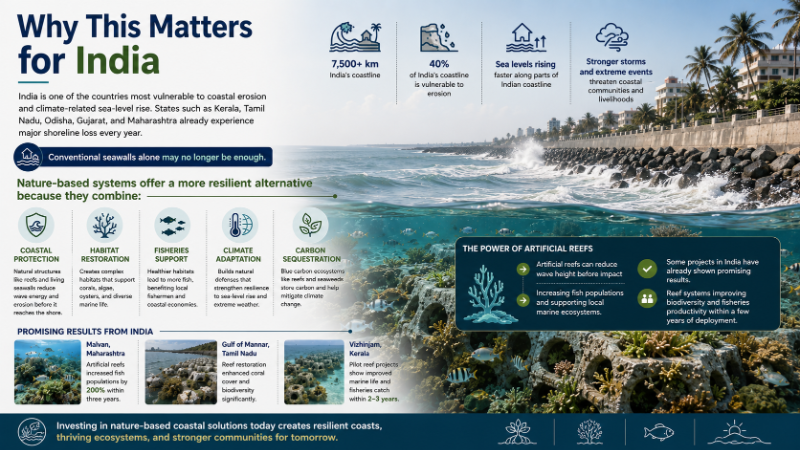
India is one of the countries most vulnerable to coastal erosion and climate-related sea-level rise. States such as Kerala, Tamil Nadu, Odisha, Gujarat, and Maharashtra already experience major shoreline loss every year.
Conventional seawalls alone may no longer be enough.
Nature-based systems offer a more resilient alternative because they combine:
Coastal protection
Habitat restoration
Fisheries support
Climate adaptation
Carbon sequestration
Artificial reefs can reduce wave height before impact while simultaneously increasing fish populations and supporting local marine ecosystems. Some projects in India have already shown promising results, with reef systems improving biodiversity and fisheries productivity within a few years of deployment.
Frequently asked
Living Seawalls: Infrastructure That Supports Life
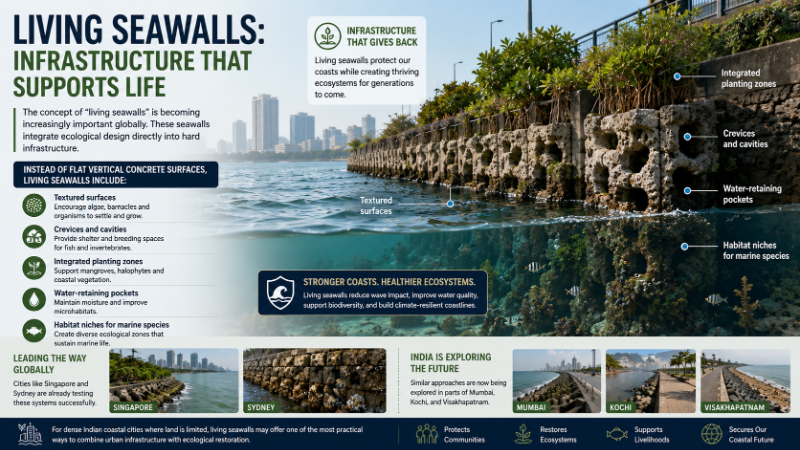
The concept of “living seawalls” is becoming increasingly important globally. These seawalls integrate ecological design directly into hard infrastructure.
Instead of flat vertical concrete surfaces, living seawalls include:
Textured surfaces
Crevices and cavities
Integrated planting zones
Water-retaining pockets
Habitat niches for marine species
Cities like Singapore and Sydney are already testing these systems successfully. Similar approaches are now being explored in parts of Mumbai, Kochi, and Visakhapatnam.
For dense Indian coastal cities where land is limited, living seawalls may offer one of the most practical ways to combine urban infrastructure with ecological restoration.
The Overlap of Architecture, Ecology, and Technology
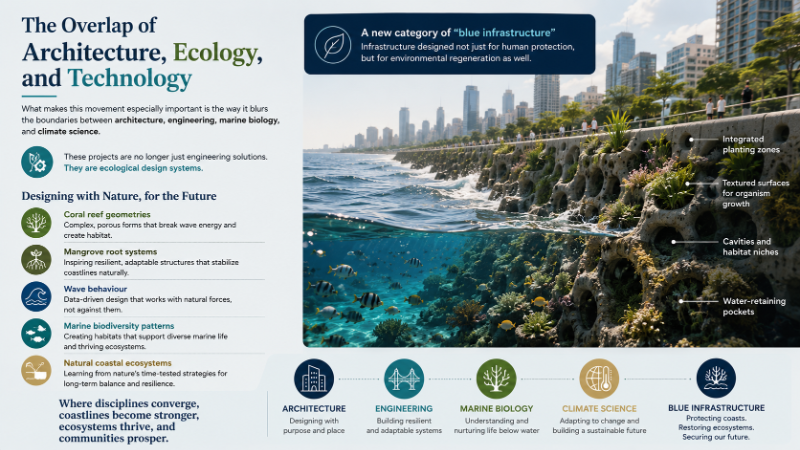
What makes this movement especially important is the way it blurs the boundaries between architecture, engineering, marine biology, and climate science.
These projects are no longer just engineering solutions. They are ecological design systems.
Architects and coastal designers are increasingly studying:
Coral reef geometries
Mangrove root systems
Wave behaviour
Marine biodiversity patterns
Natural coastal ecosystems
This is leading to a new category of “blue infrastructure” — infrastructure designed not just for human protection, but for environmental regeneration as well.
Could This Work Along Indian Coastlines?
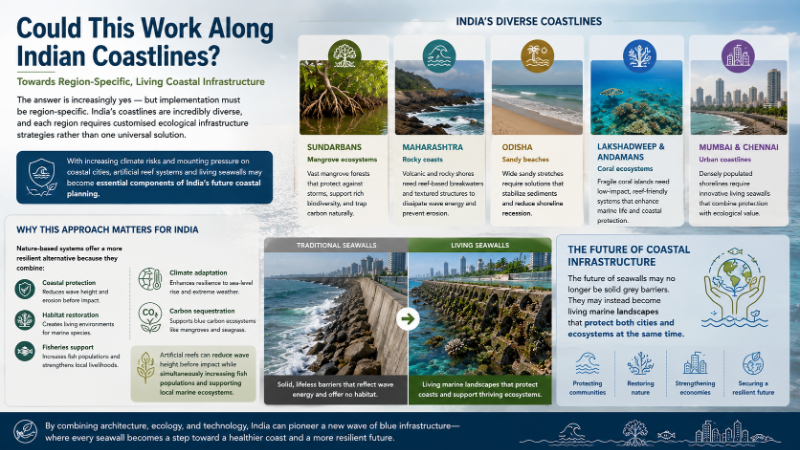
The answer is increasingly yes — but implementation must be region-specific.
India’s coastlines are incredibly diverse:
Mangrove ecosystems in the Sundarbans
Rocky coasts in Maharashtra
Sandy beaches in Odisha
Coral ecosystems in Lakshadweep and the Andamans
Urban coastlines in Mumbai and Chennai
Each region would require customised ecological infrastructure strategies rather than one universal solution.
However, with increasing climate risks and mounting pressure on coastal cities, artificial reef systems and living seawalls may become essential components of India’s future coastal planning.
The future of seawalls may no longer be solid grey barriers. They may instead become living marine landscapes that protect both cities and ecosystems at the same time.
```
