


3D-Printed Buildings in India: Is the Future of Construction Already Here?
The construction industry in India has long grappled with challenges that seem almost insurmountable: labour shortages, material waste, project delays, and the pressing need for affordable housing. According to recent estimates, India needs to build approximately 20 million new homes by 2030 to meet housing demand, particularly in urban centres like Bangalore, Mumbai, and Delhi. Traditional construction methods are struggling to keep pace with this requirement. Enter 3D printing—a technology that promises to revolutionise how we build.
3D printing in construction, also known as 3D concrete printing or additive manufacturing, is no longer science fiction. Several pilot projects across India have already demonstrated its viability, and major construction firms are investing heavily in this technology. But is it truly ready to transform India's construction landscape, or are we still years away from mainstream adoption? Let's explore the reality behind the hype.
Build cost · Bengaluru, May 2026
Understanding 3D Printing in Construction
How Robotic Concrete Printing Works
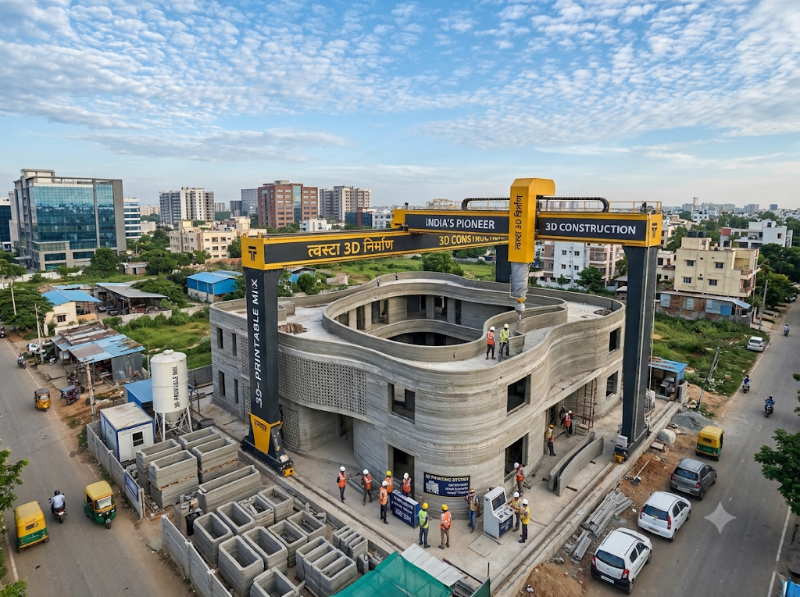
3D printing in construction operates on a surprisingly straightforward principle: a robotic arm or gantry system deposits layers of specially formulated concrete or other materials in a predetermined pattern to build structures layer by layer. Unlike traditional construction, where workers manually lay bricks or pour concrete into moulds, 3D printing automates this process with precision.
The process begins with detailed architectural designs converted into digital code that guides the printing machinery. A concrete mixture—typically a high-performance, fast-setting formulation—is fed through a nozzle attached to the robotic arm. As the arm moves horizontally and vertically, it deposits the material in continuous lines, building walls and structural elements without the need for traditional formwork or scaffolding.
The entire operation is controlled by advanced software that ensures dimensional accuracy within millimetres. Some systems can print at speeds of up to 100 millimetres per second, meaning a single-storey wall can be completed in hours rather than days. The concrete hardens rapidly, allowing subsequent layers to be added with minimal waiting time.
Materials Used in 3D Printing
The success of 3D printing depends critically on the materials used. Standard concrete won't work—it's too thick and doesn't flow smoothly through the nozzle. Instead, specially engineered concrete mixes are developed with specific properties:
Rheology Control: The concrete must have the right consistency to extrude smoothly while maintaining structural integrity. Too thin and it won't hold its shape; too thick and it won't flow through the nozzle.
Rapid Strength Gain: The material must cure quickly so that subsequent layers can be applied without excessive waiting time. This is achieved through additives and specific cement formulations.
Durability: The printed structure must be as durable as traditionally constructed buildings, capable of withstanding India's diverse climate conditions—from monsoons in Kerala to extreme heat in Rajasthan.
Cost Efficiency: Materials must be affordable to justify the technology's use in India's price-sensitive market.
Research institutions and construction companies across India are experimenting with locally sourced materials and supplementary cementitious materials like fly ash and slag, which can reduce costs and environmental impact while maintaining structural performance.
Advantages of 3D-Printed Construction
Dramatic Reduction in Construction Time
Perhaps the most compelling advantage is speed. A traditional construction project in India typically takes 18-24 months for a 4-5 storey residential building. 3D printing can reduce this to 3-6 months. In 2021, a startup in Bangalore successfully printed a 600-square-foot house in just 48 hours using 3D printing technology. While this included only structural elements and not finishing work, it demonstrated the technology's potential to accelerate construction timelines significantly.
This acceleration translates directly into cost savings. Faster project completion means lower financing costs, reduced overhead, and quicker revenue generation for developers.
Substantial Reduction in Material Waste
Traditional construction generates enormous quantities of waste. In India, construction waste accounts for approximately 12-13% of total municipal solid waste. 3D printing is inherently more efficient because material is deposited only where needed. There's no excess concrete to dispose of, no broken bricks, and minimal offcuts. Studies indicate that 3D printing can reduce material waste by up to 60% compared to conventional methods.
This is particularly significant for India, where environmental concerns are mounting and landfill space is increasingly constrained in major cities.
Labour Efficiency and Safety
India's construction sector faces chronic labour shortages and safety challenges. Construction sites are inherently hazardous, with falls, electrocution, and equipment accidents claiming thousands of lives annually. 3D printing significantly reduces the need for manual labour on-site, particularly for repetitive structural work.
While skilled workers are still required for design, material preparation, and finishing work, the dangerous task of working at heights is substantially minimised. This addresses both the labour scarcity problem and improves worker safety—a critical consideration for India's construction industry.
Design Flexibility and Customisation
3D printing enables architects and engineers to design and build structures with geometries that would be difficult, expensive, or impossible to construct using traditional methods. Complex curved walls, intricate facades, and innovative structural forms become feasible. For AECORD professionals working on high-end residential or commercial projects, this opens entirely new creative possibilities.
Potential for Affordable Housing
Perhaps most importantly for India, 3D printing offers a pathway to affordable housing. By reducing construction time, labour costs, and material waste, the total cost of construction can be reduced by 20-40% depending on the project type. In a country where affordable housing remains a critical challenge, this cost reduction could be transformative. A 2-bedroom apartment that costs ₹40-50 lakhs to construct traditionally might be built for ₹25-30 lakhs using 3D printing.
Current Limitations and Challenges
Technology Maturity and Standardisation
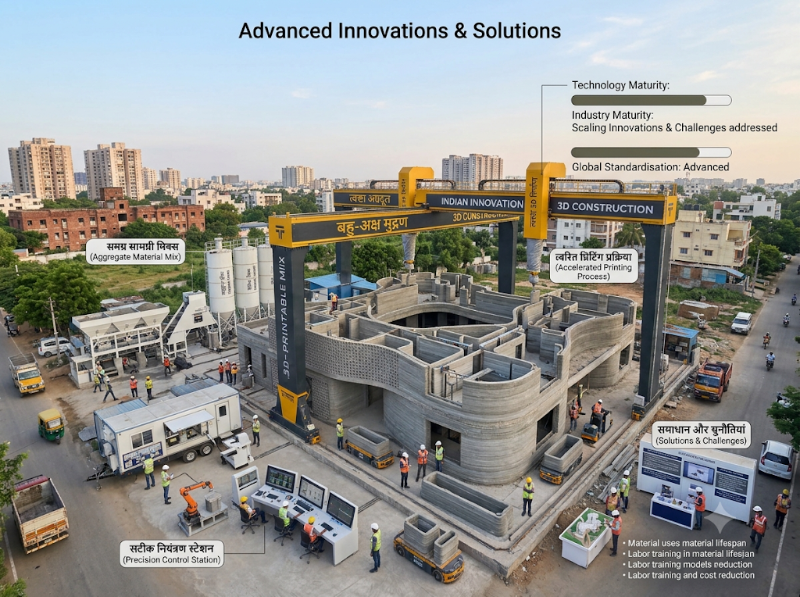
While 3D printing has demonstrated promise, it remains relatively nascent in India's construction context. Standards and building codes specifically addressing 3D-printed structures are still being developed. The Indian Standards Institution (ISI) and various state building departments are working on guidelines, but clarity remains limited. This regulatory uncertainty makes it difficult for large-scale adoption.
Additionally, most 3D printing systems are still being refined for Indian conditions. The technology has been proven in controlled environments and pilot projects, but scaling to diverse climates, soil conditions, and project types across India presents ongoing challenges.
Initial Capital Investment
3D printing equipment is expensive. A single large-scale printer can cost ₹5-15 crores, with additional costs for software, training, and site setup. This high initial investment is a significant barrier for smaller construction firms and developers, though it becomes more economical as project volume increases.
Finish and Interior Work Still Manual
3D printing excels at structural work but doesn't eliminate the need for traditional construction methods for finishing. Electrical installations, plumbing, interior walls, flooring, and other finishing elements still require manual labour and traditional techniques. This means that while construction time is reduced, the technology isn't a complete replacement for traditional construction—it's a complement.
Quality Control and Durability Concerns
Long-term durability data for 3D-printed structures in India's climate is still limited. Monsoons, temperature fluctuations, and humidity variations present challenges that require ongoing research. Additionally, ensuring consistent quality across different printing sites and operators remains a challenge that the industry is actively addressing.
Skill and Knowledge Gaps
India's construction workforce is largely trained in traditional methods. Transitioning to 3D printing requires new skill sets in robotics, software operation, and material science. Educational institutions and industry bodies are beginning to address this gap, but widespread skills training will take time.
Current 3D Printing Projects in India
Several pioneering projects demonstrate that 3D printing is moving from concept to reality in India:
Bangalore Startup Success: A Bangalore-based startup printed a 600-square-foot residential unit, showcasing the technology's feasibility for Indian residential construction.
Mumbai Infrastructure Projects: Research institutions in Mumbai are exploring 3D printing for affordable housing, with support from government bodies recognising its potential for addressing housing shortages.
Delhi Academic Initiatives: Universities in Delhi are conducting research on 3D-printed construction materials and techniques suited to North Indian climate conditions.
Pune Commercial Ventures: Several construction companies in Pune are piloting 3D printing for commercial and residential projects, building experience and refining processes.
While these projects remain relatively small-scale, they're crucial for developing expertise, understanding local challenges, and building confidence in the technology.
The Path Forward: Timeline for Mainstream Adoption
Near Term (2024-2026)
In the next 2-3 years, we can expect continued pilot projects and refinement of technology for Indian conditions. Building codes and standards will likely be finalised, providing the regulatory framework necessary for broader adoption. Early adopters—primarily large developers and construction firms—will begin integrating 3D printing for specific project types, particularly affordable housing initiatives.
Medium Term (2026-2030)
As costs decrease and expertise grows, 3D printing will likely become a standard tool in the construction industry's toolkit. We may see 10-15% of new construction projects utilising 3D printing for structural work, particularly in urban centres like Bangalore, Mumbai, Hyderabad, and Pune. Government initiatives promoting affordable housing will accelerate adoption.
Long Term (2030+)
By 2030 and beyond, 3D printing could account for a significant portion of new construction in India, particularly for standardised residential units and infrastructure projects. As technology matures and costs continue to decline, even smaller developers will have access to this capability, either through ownership or through specialised contractors.
Implications for AECORD Professionals
For architects, engineers, contractors, and operations professionals on AECORD, 3D printing represents both an opportunity and a necessity to stay competitive. Architects need to understand how to design for 3D printing—optimising geometries for additive manufacturing while maintaining aesthetic and functional requirements. Engineers must develop expertise in material specifications, structural analysis for printed elements, and integration with traditional construction methods. Contractors need to understand project management for hybrid construction approaches combining 3D printing with traditional methods.
AECORD professionals can position themselves as early adopters and specialists in 3D printing technology, differentiating their services in an increasingly competitive market.
Conclusion
Is the future of construction already here? In some ways, yes. 3D printing has moved beyond theoretical discussions into practical, real-world applications in India. However, it's more accurate to say that the future is arriving gradually, rather than suddenly. The technology is proven but still maturing. The economics are attractive but require scale. The regulatory framework is developing. The workforce is beginning to adapt.
3D printing won't replace traditional construction entirely—at least not in the foreseeable future. Instead, it will become an increasingly important tool in the construction industry's arsenal, particularly valuable for specific applications like affordable housing, infrastructure, and projects requiring rapid completion.
For India, a country facing enormous construction challenges and housing shortages, 3D printing offers genuine hope. By reducing costs, construction time, waste, and safety risks, it can contribute meaningfully to addressing housing shortages and infrastructure needs. The question isn't whether 3D printing will transform construction in India, but rather how quickly this transformation will occur.
If you're an AECORD professional interested in exploring 3D printing opportunities or seeking collaborators with expertise in this emerging technology, now is the time to connect with specialists and early adopters in this space. Visit AECORD to find professionals who are pioneering these innovations, or list your own 3D printing capabilities to connect with developers and contractors looking to adopt this transformative technology.